

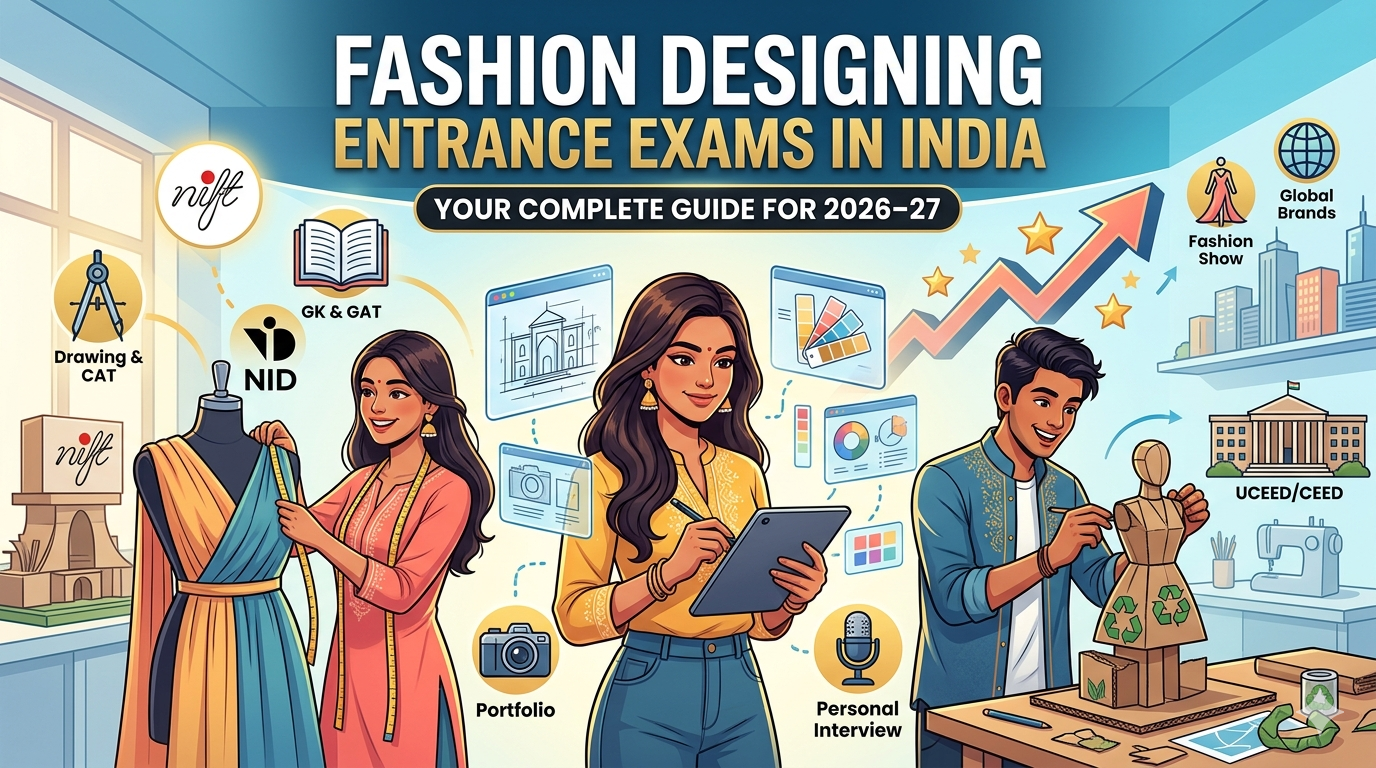
Why Entrance Exams Matter in Fashion Design
Fashion designing is no longer just about sketching pretty outfits. Today, it is a full-fledged career that blends creativity, technology, business sense, and cultural awareness. And like any professional career in India, getting into a top fashion design college requires clearing a competitive entrance exam.
Whether you dream of designing for a global luxury brand, launching your own label, or becoming a costume designer for Bollywood – the path begins with the right education. And the gateway to that education? Fashion designing entrance exams in India.
These exams are not just tests of drawing ability. They assess your creativity, spatial intelligence, general knowledge, logical thinking, and your ability to respond to real-world design challenges. The good news is that with the right preparation, anyone with a genuine passion for fashion can crack them.
In this guide, we cover everything you need to know – from the top exams and their patterns to preparation tips and career opportunities. Let’s dive in.
Top Fashion Designing Entrance Exams in India
India has a mix of government and private fashion institutes, each with its own admission process. Here’s a breakdown of the most important fashion design entrance exams you should know about.
1. NIFT Entrance Exam (National Institute of Fashion Technology)

NIFT is undoubtedly the most prestigious fashion design institute in India, with 18 campuses across the country – including Delhi, Mumbai, Bengaluru, Chennai, Kolkata, Hyderabad, Gandhi Nagar, Patna, Bhopal, Jodhpur, Guwahati, Shillong, Srinagar, Raebareli, Kangra, Kannur, Panchkula, and Thanjavur. Getting into NIFT is a dream for lakhs of students every year.
The CAT tests creativity, observation, innovation, and design sensibility through drawing-based tasks. The GAT covers English, quantitative ability, analytical reasoning, communication, and case studies. The Situation Test – unique to NIFT’s B.Des selection – is a hands-on, 3D model-making exercise that tests how you think and create under pressure.
2. NID Entrance Exam – Design Aptitude Test (DAT)
NID, headquartered in Ahmedabad, is one of the world’s top design schools. It focuses on holistic design thinking across disciplines – not just fashion but also product, communication, and experience design.
| Detail | Information |
| Courses Offered | B.Des (Design Foundation Programme), M.Des |
| Eligibility (UG) | 10+2 from any stream; Age: General candidates born after July 1, 2003 (relaxation for OBC/SC/ST/PwD) |
| Eligibility (PG) | Graduation in any discipline |
| Exam Stages | DAT Prelims → Studio Test → Personal Interview |
| Exam Mode | Online (Prelims), In-person (Studio Test) |
| Official Website | admissions.nid.edu |
The NID Design Aptitude Test (DAT) is known for its unconventional questions that test perception, creativity, and visual memory. Don’t expect a formula-based exam here – this one truly demands original thinking.
Torn between the two? This video breaks down NIFT vs NID, from courses and campuses to entrance exams and career paths.
3. UCEED (Undergraduate Common Entrance Exam for Design)
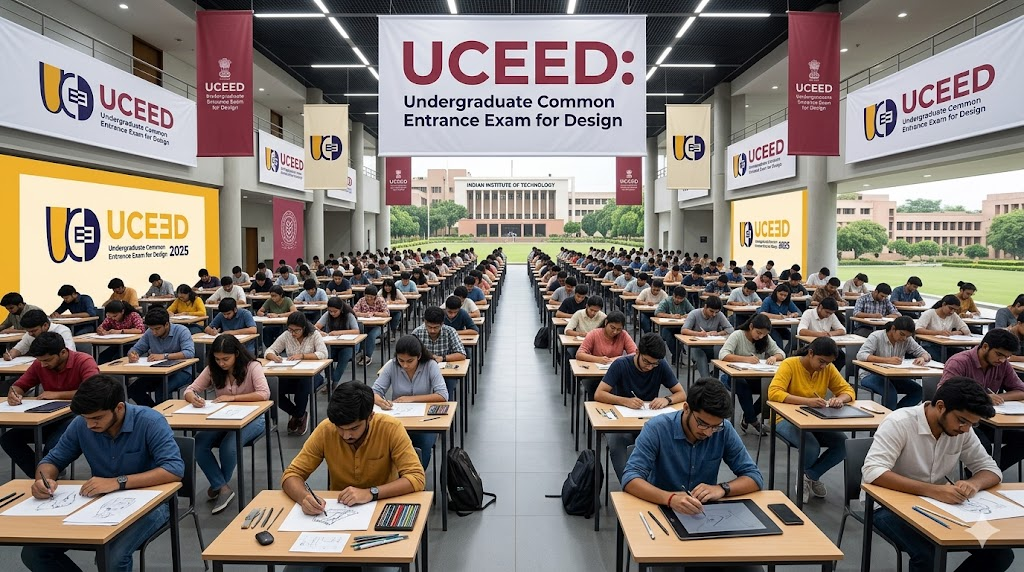
UCEED is conducted by IIT Bombay for admissions into B.Des programs at IIT Bombay, IIT Delhi, IIT Guwahati, IIT Hyderabad, IIT Roorkee, IIITDM Jabalpur, and many other design schools that accept UCEED scores.
| Detail | Information |
| Eligibility | Passed or appearing in Class 12 in 2025 or 2026; no minimum percentage requirement |
| Age Limit | Born on or after October 1, 2001 (5-year relaxation for SC/ST/PwD) |
| Exam Sections | Visualization & Spatial Ability, Observation & Design Sensitivity, Analytical & Logical Reasoning |
| Exam Mode | Computer-based (online) |
| Question Types | MCQ, MSQ, NAT, and Visual Questions (drawing on-screen) |
| Official Website | uceed.iitb.ac.in |
Unlike most design exams, UCEED has an MCQ and Numerical Answer Type component, making it partially analytical – not purely a drawing test.
4. CEED (Common Entrance Exam for Design)

CEED is the postgraduate equivalent of UCEED, also conducted by IIT Bombay. It is for students seeking M.Des admissions at IITs, IISc Bangalore, and other top institutions.
| Detail | Information |
| Eligibility | Bachelor’s degree (minimum 3 years) in any discipline |
| Part A | Computer-based: MCQ, MSQ, NAT, Visual Questions |
| Part B | Manual drawing and design tasks (evaluated offline) |
| Exam Mode | Computer-based (Part A) + Offline evaluation (Part B) |
| Official Website | ceed.iitb.ac.in |
Part B of CEED focuses on your ability to generate design ideas, sketch them clearly, and explain your thought process in writing.
5. JD Institute of Fashion Technology – GAT (General Aptitude Test)

JD Institute of Fashion Technology, established in 1988, offers courses in Fashion Design, Interior Design, and Communication Design across 40+ centres nationwide – including Mumbai, Bengaluru, Goa, Jaipur, Noida, and Kochi.
Note: Admission varies by branch – some centres require the GAT, while others admit students on a merit basis without an entrance exam.
| Detail | Information |
| Courses Offered | B.Des, M.Des, B.Sc, M.Sc, Diploma, PG Diploma |
| Eligibility (UG) | 10+2 from any recognised board |
| Eligibility (PG) | Graduation or 3-year diploma |
| Exam Name | GAT (General Aptitude Test) |
| Exam Mode | Online |
| Exam Duration | 120 minutes (GAT + Situation Test + PI) |
| Score Weightage | 60% Creative/GAT + 40% Interview |
| Application Fee | ₹1,000–1,500 |
| Official Website | jdinstituteoffashiontechnology.com |
The Situation Test assesses creativity, draping, and material handling, followed by a Personal Interview conducted in Hindi or English. JD Institute has international tie-ups with the Milan Fashion Institute and KOEFIA (Rome), with recruiters such as Manish Malhotra, Anita Dongre, H&M, and Calvin Klein.
6. Pearl Academy Entrance Exam

Pearl Academy is one of India’s leading private design and fashion schools, with campuses in Delhi, Jaipur, Mumbai, and Bengaluru. It follows a rolling admissions model with tests and portfolio reviews conducted throughout the year across multiple intakes – making it a flexible option for students who miss the NIFT/NID cycle.
| Detail | Information |
| Courses Offered | B.Des in Fashion Design, Communication Design, and more |
| Eligibility (UG) | 10+2 from any stream |
| Eligibility (PG) | Graduation in any discipline |
| Exam Components | Aptitude Test + Portfolio Review + Personal Interview |
| Admission Style | Rolling / year-round intake |
| Official Website | pearlacademy.com |
7. Other Notable Entrance Exams
- AIEED (All India Entrance Exam for Design) – accepted by 30+ design institutes
- Symbiosis Institute of Design (SID) – university-level design aptitude test
- MIT Institute of Design – MIT DAT entrance exam
- LISAA School of Design – entrance test + portfolio round
- Amity School of Fashion Technology – aptitude-based university entrance
General Eligibility Criteria
| Criterion | Details |
| Minimum Education | Pass in 10+2 (Class 12) from any recognised board |
| Stream Requirement | None — Science, Commerce, and Arts all eligible |
| Minimum Marks | No minimum % for NIFT or NID; check individual institute norms for private colleges |
| Age Limit (NIFT UG) | Max age 24 as of August 1 of admission year (relaxation for reserved categories) |
| Age Limit (NID UG) | General: born after July 1, 2003 (relaxation for OBC/SC/ST/PwD) |
| Age Limit (UCEED) | Born on or after October 1, 2001 (relaxation for SC/ST/PwD) |
| For PG Programs | Bachelor’s degree in any relevant discipline |
| Appearing Candidates | Can apply provisionally; admission confirmed after board results |
| NRI / International | Separate quotas available at NIFT and NID |
Exam Pattern & Selection Process
Most fashion designing entrance exams follow a multi-stage selection process:
Stage 1: Written / Aptitude Test
This is the first filter. It tests creative ability, general knowledge, English, quantitative aptitude, and logical reasoning. At NIFT, this is split into the CAT and GAT. At NID, it’s the DAT Prelims.
Stage 2: Studio Test / Situation Test
Shortlisted candidates appear for a hands-on round. At NIFT, this is a 3-hour Situation Test involving 3D model-making from given materials. At JD Institute, it is a timed creativity and material handling task. NID’s Studio Test includes drawing, collage, and ideation exercises.
Stage 3: Portfolio Review
Institutes like Pearl Academy and LISAA evaluate a personal portfolio — your collection of past design work, sketches, and creative projects that tells your design story beyond the exam.
Stage 4: Personal Interview
Almost all top institutes include a Personal Interview in the final stage. Expect questions on design inspiration, career goals, industry awareness, and your thought process behind portfolio pieces.
Preparation Tips
Cracking a fashion design entrance exam is not just about studying hard — it’s about developing the right eye and mindset. Here are some practical, no-fluff tips:
- Sketch every day: Even 20–30 minutes of figure drawing, object sketching, or fashion illustration daily makes a massive difference over 6 months.
- Read fashion and design publications: Stay updated with Vogue India, Elle, Architectural Digest, and Dezeen. Current trends appear in both GK rounds and interviews.
- Build your portfolio early: Collect your best work – drawings, photographs, collages, fabric experiments – and curate them into a clean, well-organised portfolio.
- Practice with previous year papers: Past papers for NIFT and NID are widely available. Time yourself strictly – the CAT is 3 hours, and endurance matters.
- Work on 3D thinking: For NIFT’s and JD Institute’s Situation Tests, practice making 3D structures from newspaper, cardboard, and fabric. Think about form, balance, and creativity.
- Sharpen your GK: Fashion history, Indian textiles, famous designers, and current affairs all appear in the GAT and interview rounds.
- Take a structured online course: Self-study works for some, but guided programs with expert mentorship can significantly accelerate your preparation. SEFT (School of Excellence in Fashion & Technology) offers comprehensive online fashion design courses designed to help aspiring designers build technical skills and exam-readiness from day one.
Syllabus Overview
| Subject Area | Key Topics |
| Creative & Drawing Ability | Fashion illustration, figure drawing, object sketching from memory, composition, colour theory, mood boarding, 3D design |
| General Knowledge | Fashion history (India & global), famous designers, Indian textiles & crafts, current affairs |
| Logical Reasoning | Pattern recognition, spatial reasoning, series completion, analogy-based questions |
| Quantitative Aptitude | Basic arithmetic, percentages, data interpretation |
| English Language | Reading comprehension, grammar, vocabulary, descriptive writing (especially for NIFT GAT) |
| Design Sensitivity | Observation skills, visual memory, design trends (especially for UCEED & CEED) |
Best Books & Resources for Preparation
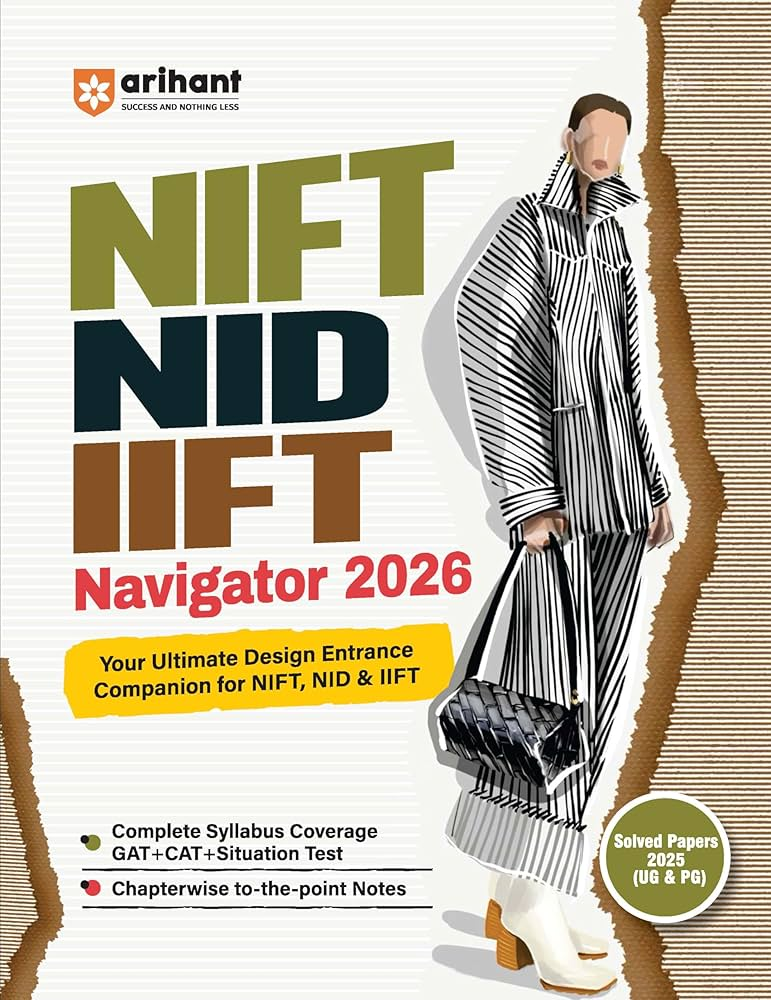
Books for NIFT & NID
| Book Title | Author / Publisher | Best For |
| NIFT/NID/IIFT Entrance Exam Guidelines | Dharmendra Mittal | NIFT & NID complete prep |
| Arihant NIFT NID IIFT Navigator 2026 | Arihant Publications | GAT, CAT & Situation Test |
| NIFT/NID 16 Years’ Solved Papers | Arihant Publications | Practice & pattern familiarity |
| NID Past Year Papers (2015–2025) | Toprankers | NID DAT Prelims practice |
Books for UCEED & CEED
| Book Title | Author / Publisher | Best For |
| Cracking CEED & UCEED | Ashok Goel & Arjun Kamal | UCEED & CEED combined prep |
| UCEED Original Previous Year Solved Papers (10 Years) | Toprankers | UCEED Part A practice |
Subject-wise Reference Books
| Book Title | Author | Best For |
| Design Drawing | Francis D.K. Ching | Technical drawing & sketching |
| Basic Rendering | Robert W. Gill | Rendering, shading & perspective |
| Perspective Drawing Handbook | Joseph D’Amelio | Spatial drawing skills |
| Quantitative Aptitude for Competitive Exams | R.S. Aggarwal | GAT math section |
| A Modern Approach to Verbal Reasoning | R.S. Aggarwal | Logical reasoning for all exams |
| Comprehensive English for Design Entrance Exams | Designologue | NID, NIFT, UCEED English section |
Free & Online Resources
- Official websites – nift.nta.nic.in, admissions.nid.edu, uceed.iitb.ac.in — for past papers and official syllabi
- YouTube – channels covering fashion illustration, sketching, and design thinking
- online fashion design courses – structured programs to build portfolio-worthy skills, design thinking, and exam readiness from home
Key Dates for the 2026 Session
⚠️ Important: The dates below reflect confirmed figures where available and projected timelines based on established annual patterns. Always verify final dates at official websites before applying, as they shift slightly each year.
| Exam | Application Window | Exam Date | Result / Next Stage |
| NIFT 2026 | Dec 8, 2025 – Jan 19, 2026 | Feb 8, 2026 | Results: Mar 20, 2026; Situation Test/PI: Apr 2026 careerpower+1 |
| NID DAT 2026 | Sep 11 – Dec 1, 2025 | Dec 21, 2025 (Prelims) | B.Des Results: Early Apr 2026; Studio Test: Apr–May 2026 itm+1 |
| UCEED 2026 | Oct 1 – Nov 10, 2025 | Jan 18, 2026 | Results: Mar 6, 2026; Seat allotment: Mar–Apr 2026 pw+1 |
| CEED 2026 | Oct – Nov 2025 | Mid-Jan 2026 | Results: Feb–Mar 2026; M.Des admissions: Mar–May 2026 |
| JD Institute GAT 2026 | Multiple phases year-round | Multiple phases | Results within ~3 days; seat confirmation follows |
| Pearl Academy | Rolling / year-round | Year-round (multiple intakes) | Results within weeks of each test cycle |
Career Opportunities After Clearing Fashion Design Entrance Exams
Clearing one of these exams opens the door to a B.Des or M.Des program — and from there, the career paths are genuinely exciting.
Courses You Can Pursue
| Program | Duration |
| B.Des in Fashion Design | 4 years |
| B.Des in Textile / Knitwear Design | 4 years |
| B.FTech (Fashion Technology) | 4 years |
| B.Sc in Fashion & Apparel Design | 3 years |
| M.Des in Fashion Design | 2 years |
| MFM (Master of Fashion Management) | 2 years |
Career Paths
- Fashion Designer (ready-to-wear, couture, or sustainable fashion)
- Textile Designer for brands or export houses
- Costume Designer for film, TV, and OTT platforms
- Fashion Stylist and Personal Shopper
- Retail Buyer or Merchandiser
- Fashion Journalist or Content Creator
- Entrepreneur – launching your own fashion label
- Fashion Educator and Trainer
India’s fashion industry is growing rapidly, with international brands expanding their presence and domestic designers going global. The opportunities are genuinely vast – provided you have the right education and skill foundation.
If you want to get a head start, exploring foundational programs in fashion design can be incredibly useful. SEFT’s online fashion design courses are structured to help students develop portfolio-worthy skills, industry awareness, and design thinking – all of which are invaluable whether you’re preparing for entrance exams or already enrolled in a design college.
Conclusion: Your Fashion Design Journey Starts Now
Preparing for fashion designing entrance exams in India might feel overwhelming at first – there’s a lot to cover, from technical drawing skills to current affairs and interview prep. But here’s the honest truth: thousands of students crack these exams every year, and what separates those who succeed is consistent, focused effort – not talent alone.
Start early. Sketch every day. Read widely. Build your portfolio. Whether you’re aiming for NIFT, NID, UCEED, JD Institute, or a top private institute, the journey to becoming a fashion designer is one of the most creatively fulfilling paths you can choose.
Your design career doesn’t begin when you get into college – it begins the moment you decide to take it seriously.
Frequently Asked Questions (FAQs)

Q1. Which is the best fashion design entrance exam in India? NIFT is the most prestigious and widely recognised fashion design entrance exam in India, followed by NID DAT and UCEED. The “best” exam depends on the institute you’re targeting – government institutes require NIFT or NID scores, IITs accept UCEED, and private institutes like JD Institute have their own GAT.
Q2. Can a Science or Commerce student apply for fashion design entrance exams? Yes, absolutely. Stream does not matter for most fashion design entrance exams in India. Science, Commerce, and Arts students are all equally eligible as long as they have completed (or are appearing in) Class 12 from a recognised board.
Q3. Is there a minimum percentage required for NIFT or NID? No. NIFT and NID do not require a minimum percentage in Class 12 – you simply need to have passed. UCEED also has no minimum percentage requirement. However, private institutes may have their own minimum marks criteria, so always check the individual brochure.
Q4. Is there negative marking in NIFT and NID entrance exams? NIFT’s GAT and NID’s DAT Prelims generally do not have negative marking. However, this can vary by year and exam section – always confirm with the official brochure before you sit for the exam.
Q5. What is the NIFT Situation Test, and how should I prepare for it? The NIFT Situation Test is a hands-on, 3-hour exercise where shortlisted B.Des candidates create a 3D model using provided materials (fabric, cardboard, paper, pins, etc.) based on a given theme. Preparation involves practising 3D model-making, improving material handling skills, and learning to think creatively under time pressure.
Q6. How many times can I attempt the NIFT entrance exam? NIFT does not impose a formal limit on the number of attempts. You can appear every year, subject to the age eligibility criteria (maximum age 24 as of August 1 of the admission year, with relaxation for reserved categories).
Q7. What is the JD Institute GAT, and how is it different from NIFT? The JD GAT is JD Institute of Fashion Technology’s in-house entrance exam, conducted online in multiple phases year-round. It consists of a Situation Test and a Personal Interview (60:40 weightage). Compared to NIFT, it is more accessible and flexible, with admissions happening across phases rather than once a year.
Q8. Do I need a portfolio for NIFT or NID? NIFT does not require a pre-submitted portfolio – creative ability is assessed live in the CAT and Situation Test. NID’s Studio Test functions as a live creative assessment. For Pearl Academy and some private institutes, a curated portfolio is a formal requirement of the selection process.
Q9. Can I prepare for fashion design entrance exams through online courses? Yes – and it’s one of the most effective options, especially for students outside major metro cities. SEFT offers structured online fashion design courses that build the creative, technical, and conceptual skills assessed in these exams, with flexibility to study from anywhere.
Q10. What is the application fee for major fashion design entrance exams? NIFT: ₹3,300 for General; ₹1,650 for SC/ST/PwD. JD Institute GAT: ₹1,000–1,500 (varies by phase). NID and UCEED fees vary by category – always check official websites for the most current figures before applying.