

So the results are out, and your name isn’t on the NIFT list. That stings – there’s no sugarcoating it. You worked hard, you had a vision, and now it feels like someone pulled the rug from under you.
But here’s what nobody tells you in that moment of disappointment: NIFT is a door, not the only door. The Indian fashion industry is worth over Rs 6 lakh crore and is one of the fastest-growing sectors in the world. This article walks you through what to do right now – starting with the two most immediate questions: Should you try again? And is NIFT even the right goal?
Before You Decide Anything – Read This First
Two things every student (and parent) should consider before choosing the next step.
Should You Try Again for NIFT?
Before exploring alternatives, ask yourself honestly: do you genuinely want to try again? NIFT allows multiple attempts, and many students crack it on their second or third try. If it’s truly your goal, don’t abandon it after one attempt.
Here’s how to make your next attempt smarter, not just harder:
- Study previous years’ papers thoroughly. NIFT papers from the last 5-7 years are widely available. The CAT (Creative Ability Test) and GAT (General Ability Test) pattern doesn’t change drastically year to year. Understand what examiners look for – it’s not always the most “artistic” sketch, but the most communicative one.
- Practice CAT sketching under timed conditions Most students lose marks not because their ideas are bad, but because they can’t execute fast enough in 3 hours. Speed and clarity matter as much as creativity. Practice daily, timed, no breaks.
- Don’t neglect GAT – it’s where many students lose marks. The General Ability Test covers English, quantitative ability, communication, and design awareness. Many students focus only on CAT and underperform on GAT. A balanced score on both is what secures a seat.
- Consider a NIFT-specific coaching programme for one year A structured prep course that mirrors NIFT’s format can significantly improve your score. Use this gap year well – build foundational design skills alongside exam prep.
- Set a limit – two attempts is a fair window Try once more if your heart is in it. But if two serious attempts haven’t worked, redirect that energy into building your career through other routes. NIFT is a starting point, not a destination.
Reality Check: The Honest Truth About NIFT’s ROI in 2025

NIFT is a great college. But like every college, it comes with a cost – and the return on that cost is not always what students and parents expect. Before committing to another attempt, here are the numbers.
| Factor | Reality (2025) | Verdict |
| Total Fees (4‑yr B.Des) | Approx. ₹14 lakh over 8 semesters | Significant investment |
| Average starting salary | ₹15,000–25,000/month for most roles | Lower than expected for most |
| NIFT 2025 Placement Highlight | Top package: ₹22 LPA; Average: ₹6–8 LPA | Strong for top performers |
| Time to break even | Realistically 5–8 years | Long payback period |
| Top earners in fashion | Skill‑driven, not degree‑driven | Portfolio and skills matter most |
| What employers ask for | Portfolio, internships, software skills | Can be built without NIFT |
Why NIFT Is Not the Only Option for a Fashion Career

NIFT admits only a few thousand students each year out of lakhs of applicants. The fashion industry, worth Rs 10 lakh crore in India in 2025, doesn’t hire based on where you studied. It hires based on what you can do – your portfolio, skills, and hustle.
Many successful Indian designers have built remarkable careers without NIFT. If NIFT didn’t work out, here are strong alternative paths you can explore right now.
Top Alternative Career Paths in Fashion (Without NIFT)
1. Fashion Designing Courses – Online & Private Institutes
India has several reputed private fashion institutes with strong industry connections. Online courses have also made quality education accessible at a much lower cost.
2. Fashion Styling
One of the fastest-growing fields in fashion. Stylists work with celebrities, brands, magazines, and e-commerce. A strong Instagram portfolio and a good styling course can help you start quickly.
3. Start Your Own Boutique or Fashion Label
Many designers began with a small Instagram store or WhatsApp catalogue. All you need is basic design knowledge, fabric understanding, and the courage to begin.
4. Fashion Communication & Media
Fashion journalism, content creation, social media strategy, and blogging are booming areas. If you enjoy writing, photography, or video, this path offers great opportunities without a design degree.
5. Textile Design
Designing prints, weaves, and surface textures for fabrics. This field has strong demand, especially if you come from a region rich in textile traditions.
6. Freelancing, E-Commerce & Social Media Careers
Fashion illustrators, stylists, and designers are successfully building businesses online. Consistent freelancers can earn Rs 30,000-50,000 per month through platforms like Instagram and Upwork.
Skills That Matter More Than the College You Attended
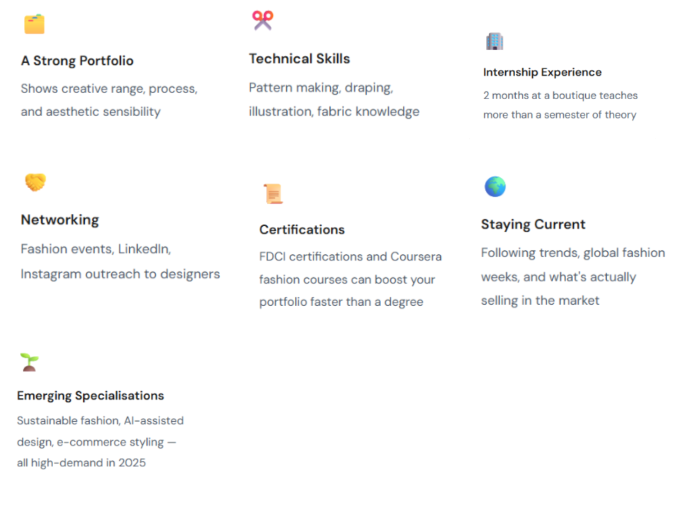
Your portfolio speaks louder than your college name. Employers want to see your work, creativity, and practical skills (like Adobe Suite and CLO3D) more than your degree. These can be developed anywhere with dedication and consistent effort.
For Parents: Dealing with Family Pressure After NIFT Results
We know you’re worried. You want the best for your child, and NIFT felt like the “safe” path – reputed, structured, and well-known. Not getting in can feel like a door slamming shut. But here’s what’s important to understand about how the fashion industry actually works today.
The “brand name college” logic doesn’t fully apply to fashion.
Unlike engineering or medicine, fashion is a creative field where your child’s portfolio – the actual work they create – matters more to employers than the college name on their degree. Fashion houses literally ask to “see your work” before anything else.
The fee vs. salary math deserves an honest look.
NIFT’s B.Des programme costs approximately Rs 14 lakh over 4 years – and starting salaries for most fashion design roles range from Rs 15,000-25,000 per month. At that rate, break-even realistically takes 5-8 years. A structured course at a fraction of the cost, combined with internships and a strong portfolio, can lead your child to the same starting point – often faster, and with far less financial pressure on the family.
The fashion industry has changed – this is not the same world you grew up in.
Instagram designers, boutique founders, fashion content creators, and freelance stylists are building real, sustainable incomes today. This is not a “backup plan” – it is a legitimate career path that generates serious revenue. Your child may be perfectly positioned for this new landscape.
What you can do as a parent right now:
Support your child in enrolling in a quality course – online or offline. Encourage internships and portfolio-building. Give them 12-18 months to show traction before making judgements. Fashion careers are often non-linear in the beginning, and that’s completely normal.
How to Start Your Fashion Career Without NIFT – Step by Step
- Take a breath and reset your mindset. Rejection is not a verdict on your talent. Give yourself time, then make a plan.
- Identify which area of fashion excites you most: Design, styling, communication, textiles, or business?
- Start learning – formally or online Join a good course (online or offline) and learn tools like CLO3D and Canva.
- Build your portfolio from day one Sketch, create, and document your work consistently.
- Intern wherever you can Practical experience and connections matter more than stipend.
- Stay active on social media Use Instagram to showcase your work and network with industry professionals.
- Keep applying and keep growing. Stay open to opportunities. Fashion careers rarely follow a straight line.