

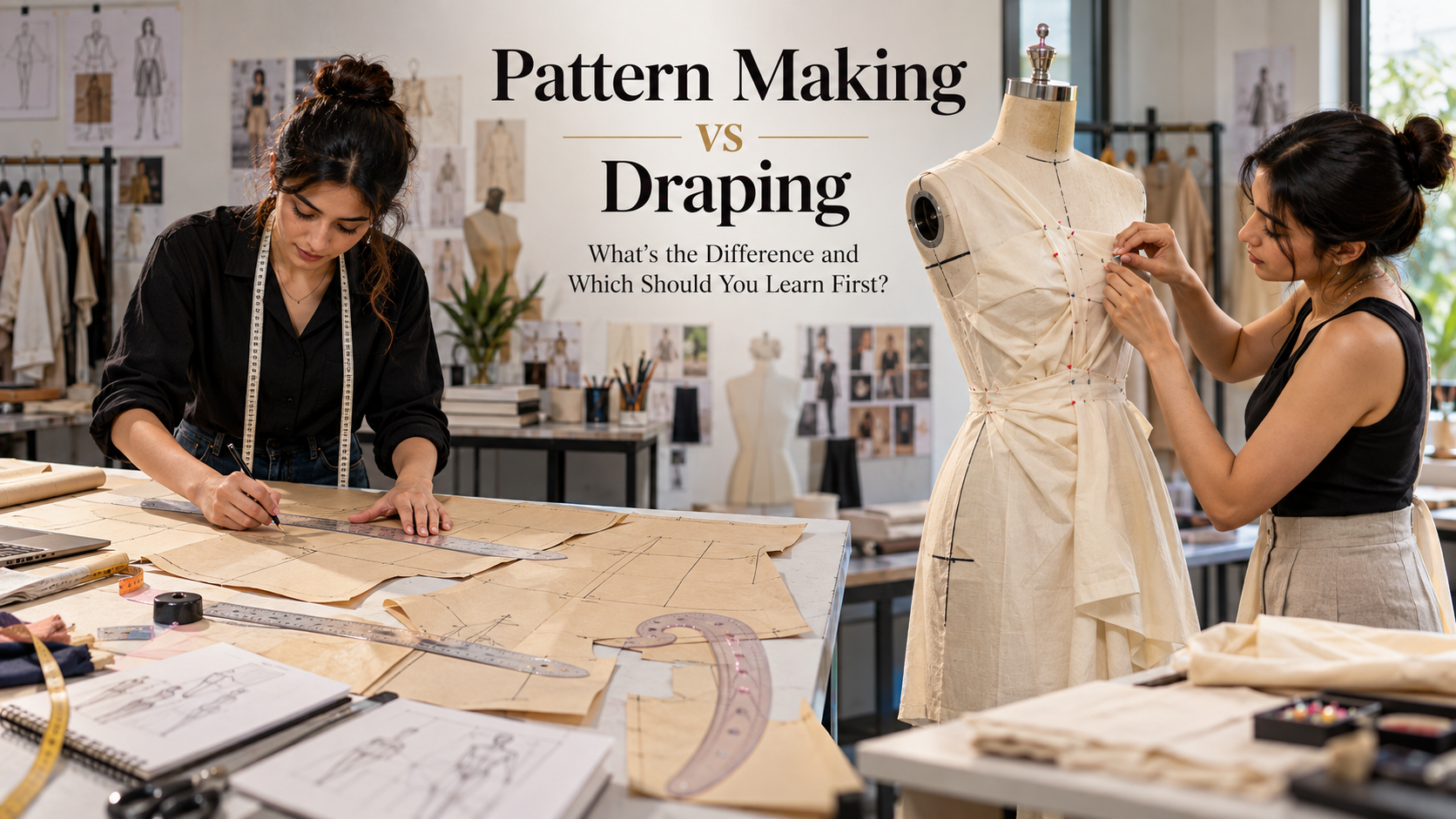
A designer can develop a garment in two very different ways.
One approach begins with measurements and a flat pattern on paper. The other begins with fabric placed directly on a dress form and shaped around the body.
These methods are known as pattern making and draping.
Both can eventually produce a garment pattern, but the way the designer reaches that pattern is different.
For beginners, the useful question is not which method is universally better. It is what each method teaches and which one makes sense to learn first for your goals.
What Is Pattern Making?
Pattern making is the process of creating two dimensional templates that determine the shapes of fabric needed to construct a garment.
Patterns may include pieces for the:
- Front and back bodice
- Sleeves
- Collar
- Skirt
- Cuffs
- Pockets
- Facings
They can also contain grainlines, notches, dart positions, fold lines and cutting instructions.
Pattern makers often begin with a basic block or sloper and modify it into different garment styles.
For example, a basic bodice block could be altered by changing the neckline, armhole, dart position or waist before being tested as a toile.
What Is Draping?
Draping creates garment shapes directly on a dress form or mannequin.
Instead of beginning with a complete flat pattern, fabric is placed on the form and manipulated through:
- Pinning
- Folding
- Pleating
- Gathering
- Tucking
- Cutting
- Shaping
Important lines are marked on the fabric, which is then removed from the form and transferred to paper to create a usable pattern.
So draping does not eliminate pattern making. It provides another way of developing the pattern.
Pattern Making vs Draping: Key Differences
| Feature | Pattern Making | Draping |
| Starting point | Measurements, block or paper pattern | Fabric on a dress form |
| Working format | Mainly 2D | Mainly 3D |
| Shape development | Lines and measurements | Fabric shaped around the body |
| Visual feedback | Shape must be interpreted from a flat pattern | Shape can be seen immediately |
| Common tools | Pattern paper, rulers, curves, pencils | Dress form, fabric, pins and scissors |
| Best suited to | Structured and repeatable designs | Volume, folds and experimental silhouettes |
| Fabric behaviour | Usually assessed during sampling and fitting | Visible during development |
| Final result | Paper or digital pattern | Usually converted into a pattern |
| Main learning focus | Measurement, fit and construction | Shape, proportion and fabric behaviour |
Fashion education commonly teaches both methods because they solve different design problems.
How Does Flat Pattern Making Work?
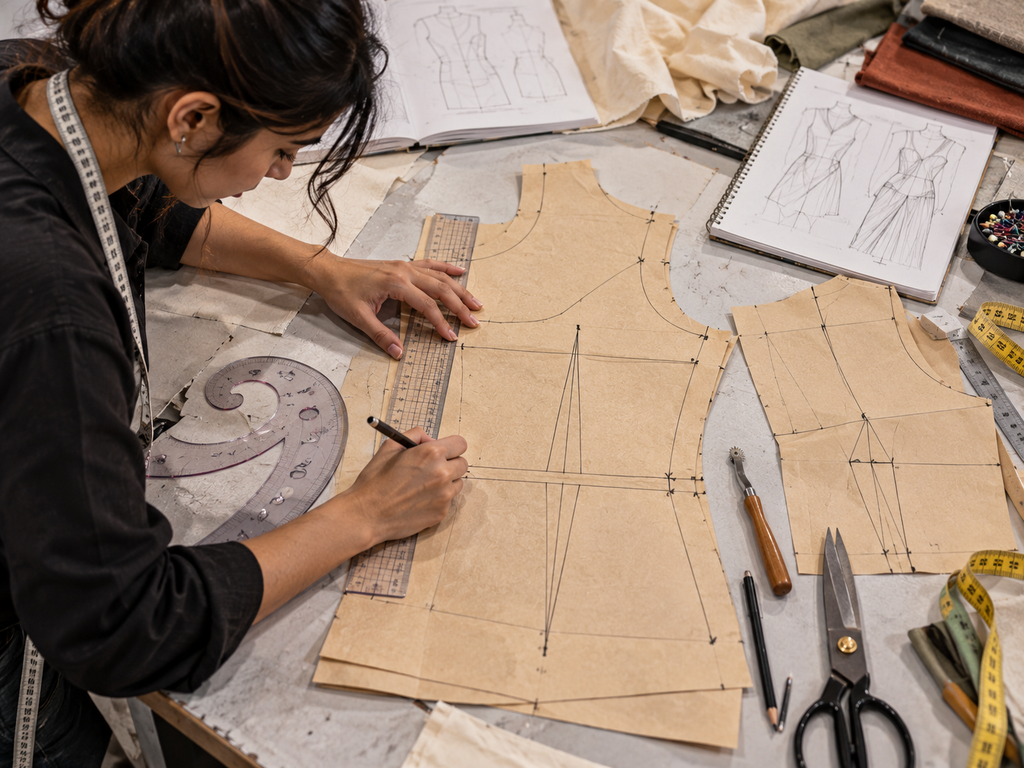
Flat pattern making usually begins with an existing block.
The designer modifies that block using techniques such as:
Slash and Spread
The pattern is cut and opened or closed to create fullness.
It can be used for:
- Gathers
- Flares
- Pleats
- Fuller sleeves
Pivoting
A section of the pattern is rotated around a point to reposition shaping.
Dart Manipulation
A dart is moved from one location to another while preserving the shaping needed around the body.
For example, a bust dart could be moved from the side seam to the shoulder or waist.
These techniques allow one basic block to become many different garments.
How Does Draping Work?
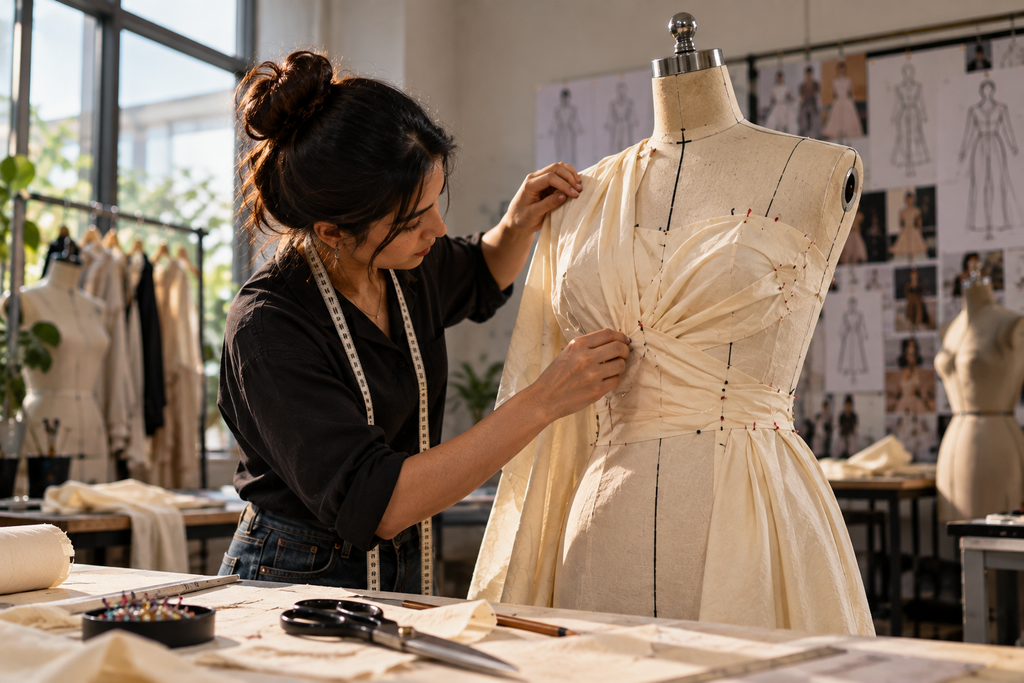
A basic draping process usually involves:
- Preparing and marking the fabric.
- Identifying the grainline.
- Positioning the fabric on a dress form.
- Securing important points.
- Shaping the fabric around the form.
- Creating darts, folds or seams.
- Marking construction lines.
- Removing the fabric.
- Transferring the shape to paper.
- Refining the pattern.
The final drape still has to be converted into an accurate pattern if the garment needs to be reproduced.
Pros and Cons of Pattern Making and Draping
| Pattern Making | Draping | |
| Advantages | Strong measurement control, repeatable patterns, useful for structured garments, easy to document | Immediate visual feedback, good for experimentation, shows fabric behaviour, useful for complex silhouettes |
| Limitations | Requires beginners to imagine a 3D result from a flat shape, complex drapes can be harder to calculate | Requires a dress form and test fabric, finished drape usually still needs pattern refinement |
Pattern making is particularly useful for shirts, trousers, jackets and other garments where controlled measurements matter.
Draping is particularly useful for cowls, pleats, bias designs, asymmetrical garments and sculptural silhouettes.
Which Method Is Better for Fit?
Neither automatically produces better fit.
Pattern making gives strong measurement control.
Draping gives immediate visual information about how a garment sits on a three dimensional form.
A fitted bodice could therefore be created from a block and checked through a toile, or developed directly through draping and later converted into a paper pattern.
The quality of the fit depends on accurate development and fitting, not simply on which method was used first.
Which Method Gives More Creative Freedom?
Draping often feels more spontaneous because fabric can be moved directly on the form.
This is especially useful for unusual shapes, twists, folds and volume.
Pattern making offers a different kind of creativity.
Once you understand blocks, darts, slash and spread and pattern manipulation, you can deliberately transform a basic shape into many different styles.
Professional fashion training therefore often combines both approaches rather than treating creativity as belonging only to draping.
Pattern Making or Draping: Which Should Beginners Learn First?
For most beginners who want a broad understanding of garment construction, basic pattern making is a practical starting point.
A useful sequence is:
Measurements → Basic block → Dart manipulation → Pattern alterations → Toile → Fit correction
This helps you understand why garment pieces have particular shapes and how measurements, darts, seams, grainlines and ease affect fit.
You can then add draping:
Dress form preparation → Basic drape → Shape development → Marking → Transfer to paper
However, this is not a strict rule. Beginner draping courses can be taught without requiring previous pattern cutting experience.
What Should You Learn First Based on Your Goal?
| Your goal | Useful starting point |
| Understand garment construction | Pattern making |
| Learn blocks and measurements | Pattern making |
| Design shirts, trousers and structured garments | Pattern making |
| Explore dramatic silhouettes | Draping |
| Work with folds, cowls or asymmetry | Draping |
| Explore sculptural fashion | Draping |
| Learn digital garment software later | Pattern making fundamentals |
| Build a complete fashion design skill set | Learn both |
Even if you begin with draping, pattern making becomes useful when the design needs to be converted into a repeatable garment.
Likewise, students who begin with pattern making can later use draping to better understand volume and fabric behaviour.
Do Professional Designers Use Both?
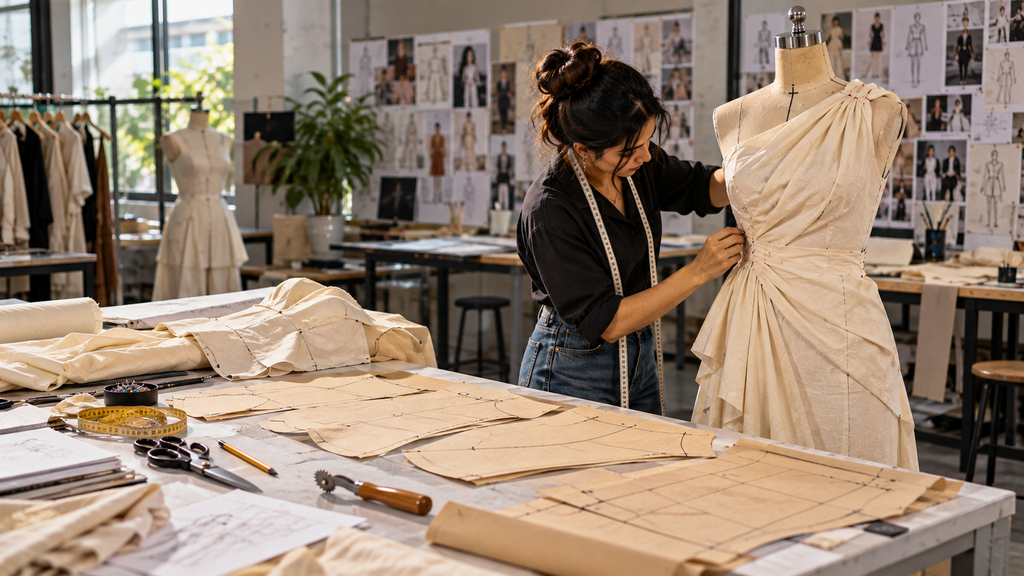
Yes.
Fashion development does not always follow one method from beginning to end.
A designer might:
- Start with a bodice block.
- Make a toile.
- Place it on a mannequin.
- Drape an additional panel.
- Mark the new shape.
- Transfer it to paper.
- Refine the complete pattern.
Pattern making and draping often complement each other within the same garment.
Where Does Digital Pattern Making Fit?
Modern software allows designers to edit flat patterns and view the resulting garment on a digital avatar.
Understanding traditional concepts such as:
- Grainline
- Dart manipulation
- Ease
- Fit
- Balance
- Seam relationships
- Fabric behaviour
still makes digital tools easier to use effectively.
Someone planning to learn software such as CLO 3D can therefore benefit from basic pattern making knowledge.
A Simple Learning Path for Beginners
A balanced progression could be:
Sewing basics → Measurements and terminology → Basic blocks → Flat pattern manipulation → Toile and fitting → Basic draping → Creative draping → Combining both methods
This is not an industry rule. It is simply a practical sequence for building skills gradually.
Frequently Asked Questions
What is the main difference between pattern making and draping?
Pattern making develops garments mainly through two dimensional patterns, measurements and blocks. Draping develops the shape directly in three dimensions using fabric on a dress form.
Is draping easier than pattern making?
Not necessarily. Some beginners find draping more visual, while others prefer the structure of flat patterns and measurements.
Should fashion designers learn both?
Learning both is useful because pattern making develops construction and measurement skills, while draping strengthens understanding of volume, proportion and fabric behaviour.
Can you learn draping without pattern making?
Yes. Beginners can start with basic draping. Pattern making becomes increasingly useful when the draped design needs to be converted into a clean, repeatable pattern.
Can you learn pattern making without draping?
Yes. Many garments can be developed entirely through flat pattern techniques and fitting. Draping can be added later to strengthen your understanding of fabric and three dimensional form.
Can draping become a sewing pattern?
Yes. Once the fabric has been shaped and marked, it can be removed from the dress form, transferred to paper and refined into a usable pattern.
Conclusion
Pattern making and draping are not competing methods.
They are two different ways of developing garments.
Pattern making approaches a garment through measurements, blocks and flat shapes.
Draping develops the garment directly with fabric in three dimensions.
For most beginners seeking a strong garment construction foundation, basic pattern making is a practical place to start. Draping can then expand that knowledge by introducing more direct work with volume, fabric and the body.
The long term goal should be to understand both well enough to choose the method that best suits the garment you want to create.