

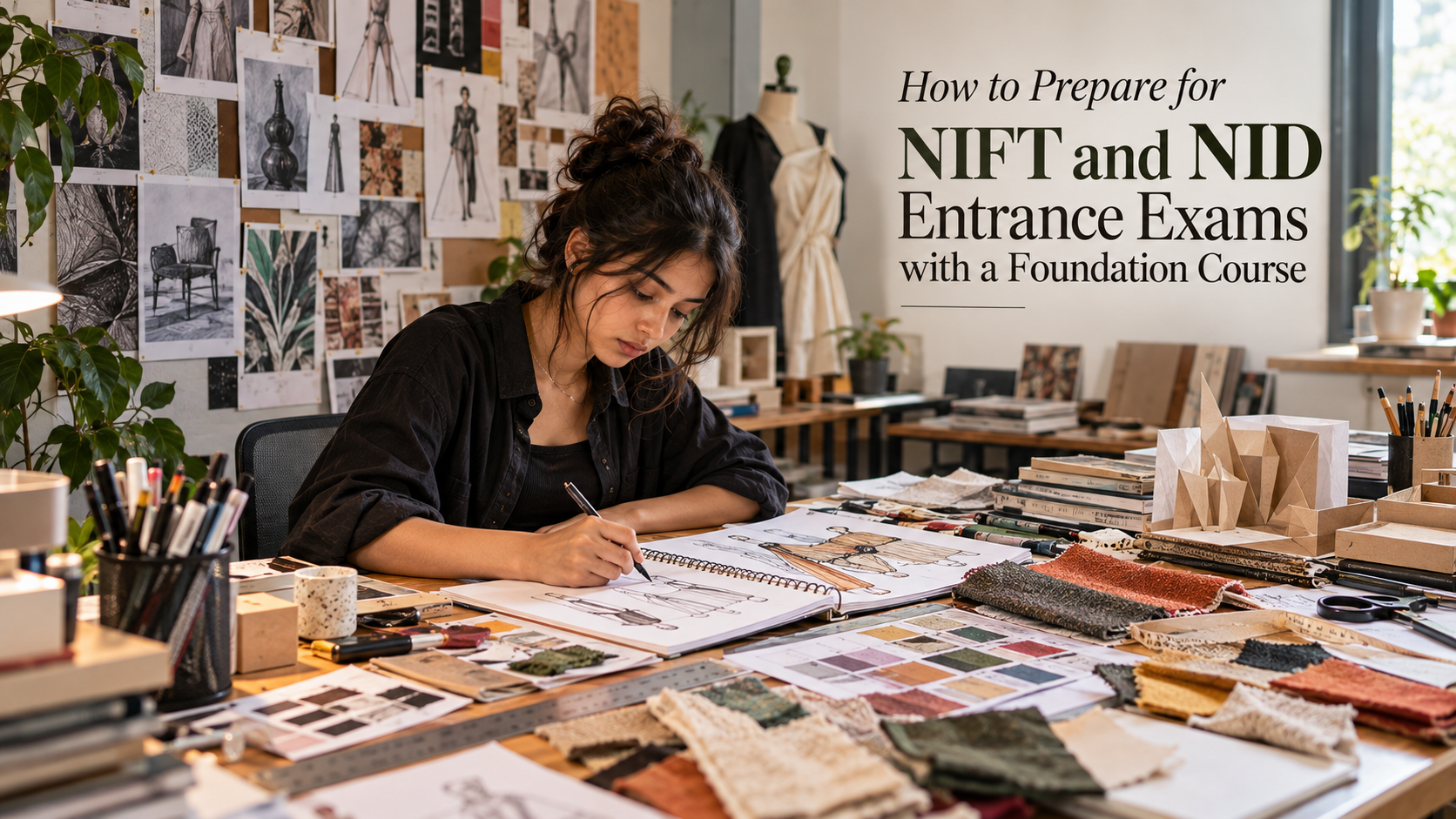
Preparing for NIFT or NID is not only about solving mock papers or learning exam tricks. Design entrance exams also require students to observe, imagine, develop ideas, communicate visually and solve unfamiliar problems.
That is where a fashion or design foundation course can help.
A good foundation programme can strengthen drawing, colour understanding, visual communication, design thinking, material exploration and project development. These skills can support entrance preparation while also providing a useful base for future design education.
A foundation course should not be treated as a secret formula for an entrance exam. Its purpose is to help students become stronger and more confident beginners in design.
What Do NIFT and NID Entrance Exams Test?
NIFT and NID have different admission processes, so students should always follow the latest official admission information.
NIFT B.Des
The NIFT B.Des process includes:
- GAT (General Ability Test)
- CAT (Creative Ability Test)
- Situation Test for shortlisted candidates
CAT focuses on areas such as observation, concept development, design ability, colour and illustration.
The Situation Test involves creating a three-dimensional model or prototype from given materials and explaining the concept, inspiration, materials and construction. It can assess creativity, visualisation, aesthetics, material handling, proportion, stability and conceptual clarity.
NID B.Des
NID uses the Design Aptitude Test (DAT), which includes:
- DAT Prelims
- DAT Mains for shortlisted candidates
The structure of the examination can change from one admission cycle to another, which is why students should prepare broad design abilities rather than relying entirely on an older question pattern.
NIFT vs NID Preparation
There is overlap between the skills useful for both exams, but their assessment structures are different.
| Area | NIFT B.Des | NID B.Des | Useful Foundation Skill |
| Creative thinking | Important | Important | Idea generation |
| Observation | Important in CAT | Relevant to design aptitude | Observational sketching |
| Drawing | Visual communication | Communicating ideas | Sketching fundamentals |
| Colour | Part of CAT | Useful for visual solutions | Colour theory |
| 3D thinking | Situation Test | Practical design tasks | Material exploration |
| General aptitude | GAT | Different DAT structure | Exam-specific practice |
| Design communication | Important | Important | Visual storytelling |
| Material handling | Situation Test | Practical evaluation | Craft and material exercises |
A foundation course can support these skills, but students should still prepare separately for the current requirements of each entrance exam.
What Is a Fashion or Design Foundation Course?
A foundation course introduces students to the basic ways designers observe, think, experiment and communicate.
A useful programme may include:
- Freehand drawing
- Observation
- Colour theory
- Composition
- Fashion illustration
- Design thinking
- Visual storytelling
- Basic textile understanding
- Material exploration
- Mood boards
- Concept development
- Garment and silhouette awareness
- Creative projects
- Portfolio organisation
The goal is not to predict an entrance question. It is to make unfamiliar creative tasks easier to approach.
How Can a Foundation Course Help With NIFT Preparation?

1. Develops Observation
Students often focus on drawing beautifully, but observation comes first.
They need to notice things such as clothing folds, perspective, proportions, movement, overlapping objects and important visual details.
Instead of practising only fashion figures, students can sketch everyday subjects such as people, markets, classrooms, objects and street scenes.
The goal is not photographic realism. It is learning to see and communicate.
2. Improves Visual Communication
A strong idea is not enough if the viewer cannot understand it.
Students should practise communicating:
Who is involved? What is happening? Where is it happening? What is the main idea? What should the viewer notice first?
This develops composition, hierarchy and visual storytelling.
3. Builds Colour Understanding
Students do not need to use many colours. They need to understand how colours work together.
Useful exercises can explore:
- Warm and cool colours
- Contrast
- Complementary colours
- Limited colour palettes
- Colour hierarchy
- Mood through colour
- Colour in fashion and visual storytelling
4. Develops Idea Generation

One common beginner challenge is not knowing what to do when given an unfamiliar brief.
Instead of immediately producing one final drawing, students can learn to move through:
Problem → Research → Ideas → Selection → Visual Solution
For example, a brief to design a bag for a daily bicycle commuter can lead to questions about storage, weather protection, visibility, comfort and accessibility before the final concept is developed.
This builds design thinking rather than memorisation.
5. Introduces Material Exploration
NIFT’s Situation Test makes three-dimensional thinking particularly relevant.
Foundation projects can allow students to experiment with simple materials such as:
- Paper
- Cardboard
- Thread
- Fabric scraps
- Straws
- String
- Coloured paper
Students learn what materials can fold, bend, support, connect or form into structures.
This creates a connection between a creative idea and a physical solution.
6. Builds Design Vocabulary
Students gradually become familiar with concepts such as:
Silhouette, proportion, balance, rhythm, contrast, texture, composition, pattern, form, function, scale and structure.
These terms become more useful when students apply them to real projects instead of simply memorising definitions.
7. Builds Comfort With Open-Ended Briefs
Design questions may have several possible solutions.
For example, a brief inspired by monsoon weather could lead to a concept based on waterproof materials, umbrella shapes, rainy-city colours or commuter needs.
The important skill is developing and communicating a clear concept.
Where Does Portfolio Development Fit In?

A portfolio is a collection of selected creative work that demonstrates how a student thinks and develops ideas.
Even when a portfolio is not an official entrance requirement, creating one can still be useful for tracking progress and preparing for broader design education.
A beginner portfolio might include:
- Observation drawings
- Fashion illustrations
- Mood boards
- Colour studies
- Textile experiments
- Product ideas
- Material explorations
- Photography
- Collage
- Design development pages
- Finished projects
A portfolio should not simply contain polished drawings. Showing the process can be more valuable:
Inspiration → Mood Board → Colour Palette → Experiments → Fabric Ideas → Final Design
Foundation Course vs Entrance Coaching
These are not the same thing.
| Foundation Course | Entrance Coaching |
| Builds long-term creative fundamentals | Focuses more directly on examination performance |
| Develops drawing and observation | Often focuses on exam-style practice |
| Encourages experimentation | Usually follows a defined test structure |
| Can support portfolio development | Portfolio may not be the focus |
| Teaches design thinking | May emphasise timed questions |
| Useful beyond entrance exams | Primarily linked to admission preparation |
A foundation course should be positioned honestly as skill development, not as guaranteed admission preparation.
What Should a Good Foundation Course Include?
When comparing programmes, look beyond promotional claims.
A useful course should provide opportunities to practise:
Drawing
Not just fashion figures, but people, objects, spaces and everyday situations.
Observation
Understanding proportion, function, behaviour and visual details.
Visualisation
Imagining objects, forms and scenes from different viewpoints.
Composition
Learning how objects, people and empty space work together.
Design Thinking
Solving problems instead of simply decorating objects.
Colour
Using colour with purpose, mood and hierarchy.
3D Exploration
Working with physical materials and understanding form and structure.
Feedback
Receiving explanations about why a solution works or needs improvement.
Independent Projects
Making design decisions instead of only copying demonstrations.
Portfolio Documentation
Recording projects and development over time.
What Should a Foundation Course Not Promise?
Students should be cautious about claims such as:
- Guaranteed NIFT admission
- Guaranteed NID admission
- Guaranteed rank or campus
- Exact entrance questions
- Secret questions
- Unverified official affiliation
- Guaranteed selection
Entrance preparation should be treated as skill development and informed practice, not as a guaranteed outcome.
A Practical Preparation Routine
A foundation course provides structure, but regular independent practice is equally important.
| Activity | Focus |
| Observation sketching | People, objects and spaces |
| Creative drawing | Imaginative and story-based prompts |
| Design problem solving | Products, clothing, spaces or communication |
| Colour exercises | Palette and contrast |
| 3D projects | Material and structure |
| Aptitude practice | Relevant exam requirements |
| Visual research | Fashion, design, architecture and products |
| Portfolio documentation | Record completed work |
| Reflection | Review strengths and improvements |
This is a practical learning framework, not an official NIFT or NID timetable.
Should You Prepare Differently for NIFT and NID?
Yes.
There is overlap in useful creative skills, but the entrance processes are not identical.
For NIFT, students should pay attention to the current requirements for GAT, CAT, observation, illustration, colour, concept development and three-dimensional material handling where applicable.
For NID, students should follow the current DAT requirements and prepare broadly for design aptitude, visual problem solving and the announced Prelims and Mains structure.
Avoid assuming that a previous year’s exam pattern will remain unchanged.
When Should You Start Preparing?
There is no single starting point that works for every student.
Early Preparation
Focus on:
- Drawing regularly
- Studying design
- Experimenting with colour
- Making things
- Photography and crafts
- Fashion and visual research
Closer to the Entrance Exam
Add:
- Current exam structure
- Timed practice
- Aptitude preparation
- Official guidance material
- Exam familiarity
- Current admission instructions
Starting early gives students more time to develop creative fundamentals, but students who begin later can also make progress through consistent practice.
Who Can Benefit From a Foundation Course?
A foundation course may be useful for students who:
- Have never formally studied design
- Want to improve drawing
- Find creative entrance questions intimidating
- Want structured design projects
- Need feedback
- Want to explore whether design suits them
- Want to begin developing a portfolio
- Want stronger fundamentals before entering a full design programme
It can also help students exploring different areas such as fashion, communication design, product design and other creative disciplines.
Frequently Asked Questions
Is a foundation course the same as NIFT coaching?
No. A foundation course develops broader skills such as drawing, observation, colour, design thinking, material exploration and project development. Entrance coaching is generally more directly focused on test preparation.
Does NIFT require a portfolio for B.Des admission?
Students should not assume that a portfolio is required. Follow the current admission information for the applicable year.
Portfolio development can still be useful for broader design education and tracking creative progress.
Does NID recommend coaching?
Students should rely on NID’s official admission information rather than claims from third-party coaching providers.
Can I prepare for NIFT if I am not good at drawing?
Yes. Drawing can improve with practice, and entrance preparation involves more than drawing alone. Observation, concept development, colour and visual communication are also important.
Can the same foundation course help with both NIFT and NID?
A course that develops broad design fundamentals can support preparation for both, since skills such as observation, visual communication, idea development and material exploration are transferable.
However, students should prepare separately for the current structure of each examination.
Is a foundation course useful only for entrance exams?
No. Skills such as drawing, design thinking, colour, visualisation, material exploration and portfolio development can remain useful throughout formal design education.
Conclusion
Preparing for NIFT or NID is not simply about memorising questions or following shortcuts.
A strong foundation can help students learn to observe carefully, develop ideas, communicate visually, experiment with colour, work with materials and solve creative problems.
These skills can support entrance preparation while also creating a stronger base for design education.
The most effective approach is to combine strong creative fundamentals with current, exam-specific preparation.
A foundation course builds the base. The current entrance guidelines explain how that year’s selection process works. Keeping these two roles separate makes preparation more practical, focused and realistic.