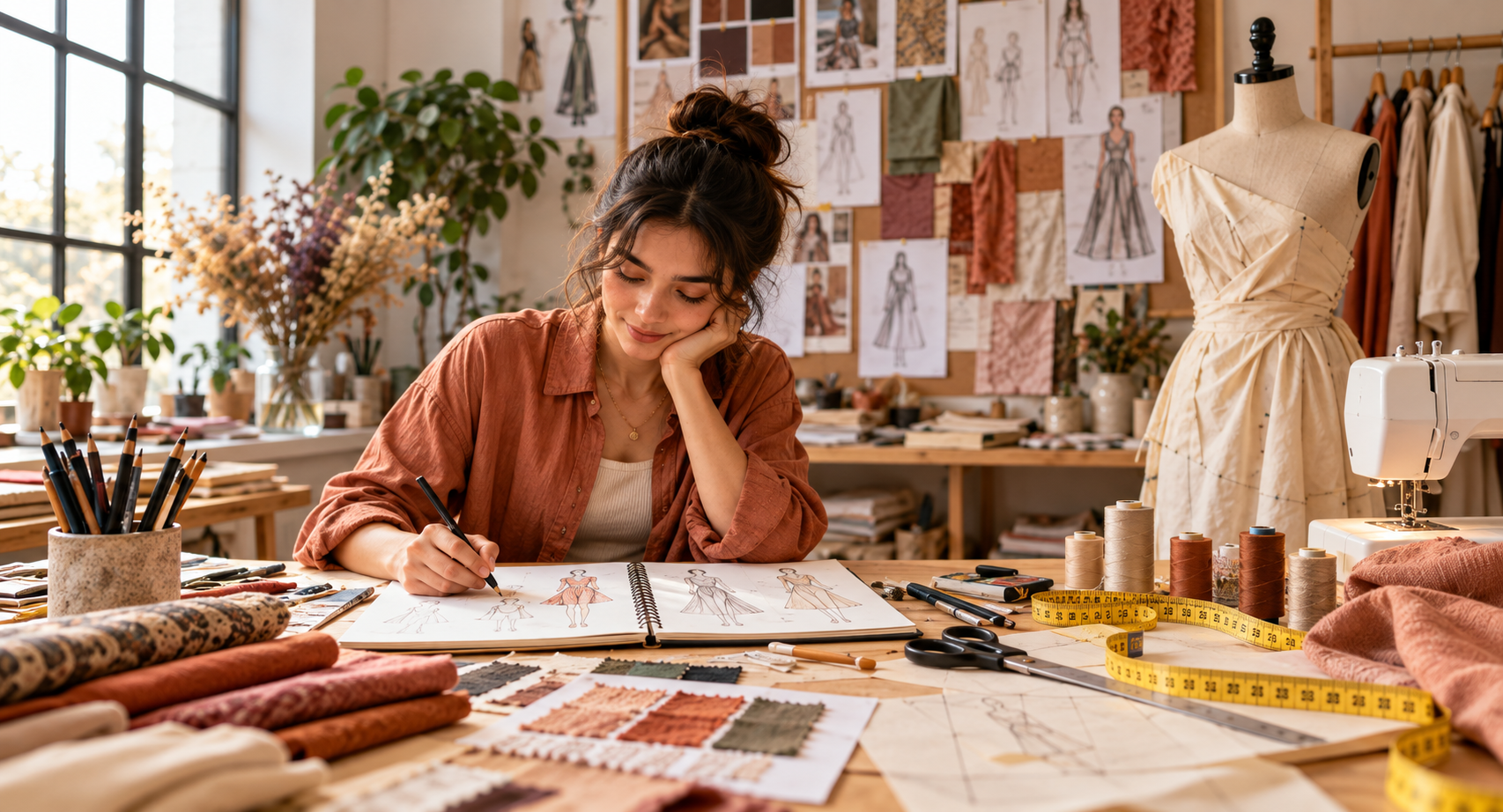
If you are thinking about studying fashion design, you may wonder whether you already need to draw well, sew confidently or understand fabrics.
You do not.
Fashion design can feel difficult at first because you are learning several creative and technical skills at the same time. Some students struggle with drawing, while others find sewing, pattern making, measurements or fabric handling more challenging.
The important thing to remember is:
Fashion design is learnable.
You do not need to start with every skill. You need patience, regular practice and a willingness to improve step by step.
So, is fashion designing hard?
It can be challenging in the beginning, but absolute beginners can learn it gradually.
Why Does Fashion Designing Feel Difficult at First?
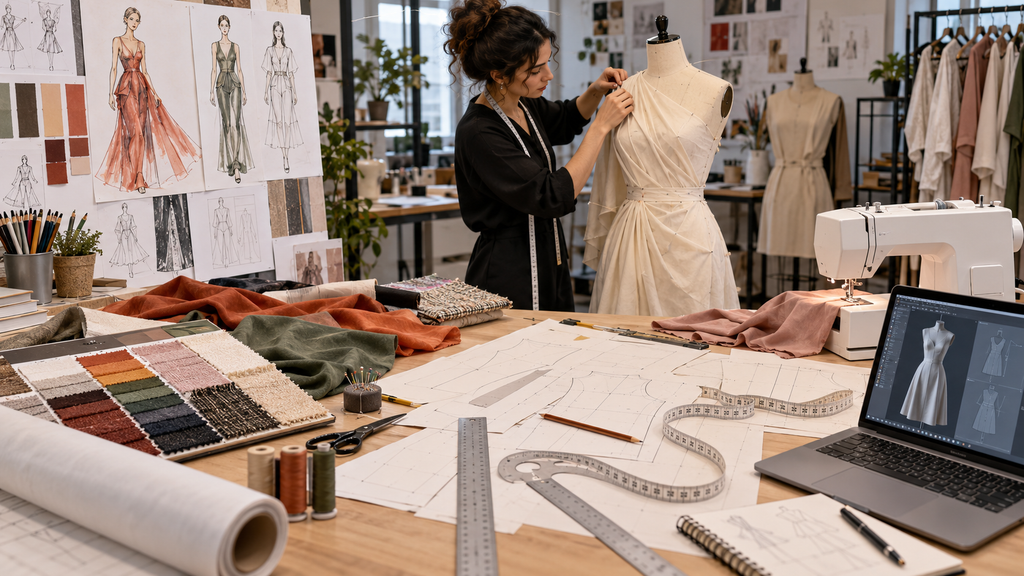
Fashion design is not just about sketching clothes.
A fashion student may learn:
- Fashion illustration
- Colour theory
- Fabric knowledge
- Pattern making
- Sewing
- Draping
- Garment construction
- Design research
- Portfolio development
- Digital fashion tools
- Presentation
- Basic fashion business
This can initially feel overwhelming because you are learning how to take an idea from inspiration to a finished garment.
The good news is that you do not learn everything at once.
Is Fashion Designing Hard If You Cannot Draw?
No.
Fashion illustration is mainly a way to communicate ideas. Your sketches help explain things such as:
- Silhouette
- Proportion
- Colour
- Garment details
- Fabric ideas
You do not need to be a professional artist before starting fashion design.
Instead of trying to create perfect illustrations immediately, practise individual skills such as fashion figures, garment shapes, sleeves, necklines, folds and fabric textures.
A clear sketch that communicates your design is often more useful than an artistic drawing that does not explain how the garment works.
Do You Need to Know Sewing Before Studying Fashion Design?
No. Many students begin without advanced sewing skills.
However, sewing becomes important because it teaches you how garments actually work.
You begin to understand:
- Seams and seam allowances
- Sleeves and armholes
- Zips and closures
- Hems and finishing
- Construction limitations
- How fabric behaves
Your first sewing projects may be slow or imperfect. That is normal.
Sewing improves through repetition.
Is Pattern Making Difficult?
Pattern making is one of the subjects many beginners initially find intimidating because it involves measurements, lines, curves, darts and accuracy.
But patterns become easier once you understand what each shape represents.
You gradually learn how the shoulder, armhole, waist, darts, ease and different pattern pieces work together.
A useful learning sequence is:
Basic skirt → Basic bodice → Sleeve → Simple dress → Shirt → Trousers → Complex garments
Trying to jump directly into complicated garments usually makes pattern making feel harder than it needs to be.
What Is the Hardest Part of Fashion Designing?
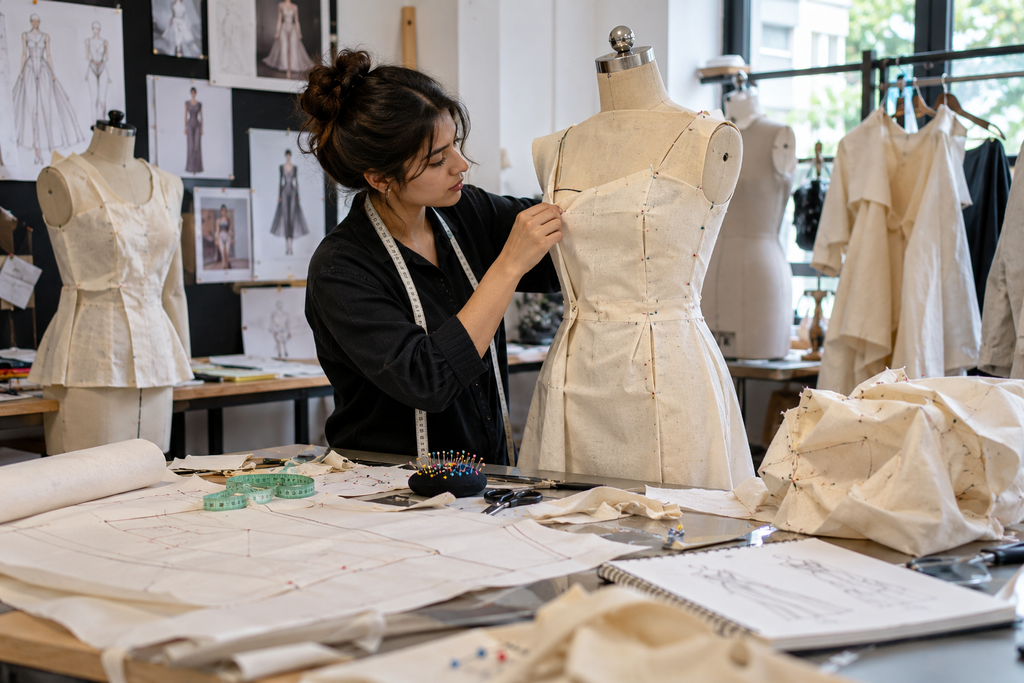
There is no single hardest skill because every student has different strengths.
However, some challenges are common.
Turning Ideas Into Real Garments
A design may look excellent on paper but be difficult to construct.
You eventually learn to ask:
- How will the garment open?
- Can the wearer move comfortably?
- Will the fabric support the shape?
- Where should the seams go?
- Can the detail actually be sewn?
This is where creativity meets technical understanding.
Understanding Fabric
The same pattern can look completely different in different fabrics.
Lightweight fabric may drape softly, while a stiff fabric creates structure. Stretch fabrics behave differently from woven materials.
Fabric knowledge develops through handling, testing and experience.
Learning From Mistakes
Fashion design involves constant correction.
A sleeve may not fit. A pattern may need adjustment. A fabric may not behave as expected.
The goal is not to avoid every mistake. It is to understand why something went wrong and improve the next version.
Managing Time
Fashion projects often involve:
Research → Sketching → Pattern Making → Fabric Selection → Sampling → Fitting → Corrections → Construction → Presentation
Even simple-looking projects can take significant time.
Learning to plan each stage makes fashion design much more manageable.
Do You Need to Be Naturally Creative?
Creativity helps, but creativity can also be developed.
Designers rarely wait for a perfect idea to suddenly appear. They build ideas through research and experimentation.
You can improve creativity by:
- Creating mood boards
- Studying art and design
- Observing architecture and people
- Experimenting with materials
- Sketching multiple alternatives
- Combining unrelated ideas
- Asking “what if?” questions
For example:
What if a jacket was inspired by folded paper?
What if a dress used colours inspired by a city at night?
Creativity becomes easier when you practise developing ideas instead of waiting for inspiration.
Do You Have to Follow Fashion Trends?
You should understand trends, but you do not have to copy them.
Trend research can help you understand:
- Changing colours
- Popular silhouettes
- Consumer interests
- Cultural influences
- Changing fashion preferences
But good fashion design still requires individual judgement and original thinking.
Trend awareness is a tool, not a replacement for creativity.
Is Digital Fashion Difficult to Learn?
Digital tools can initially feel complicated because you are learning both fashion concepts and software.
Fashion software may be used for:
- Illustration
- Pattern making
- Technical drawings
- 3D garment design
- Presentations
It is usually easier to understand the fashion concept first and then learn the software that supports it.
For example, knowing basic pattern making makes 3D garment software easier to understand.
How Long Does It Take to Learn Fashion Designing?
There is no fixed timeline.
You can learn basic concepts within months, but professional ability develops over a longer period.
Your progress depends on:
- How regularly you practise
- What skills you are learning
- The quality of feedback
- How many real projects you complete
- Your previous experience
- The level you want to reach
You may become comfortable with illustration quickly while needing more time for garment construction or patterns.
Instead of asking, “How long until I know fashion design?”, ask:
“What can I learn next?”
How Difficult Are Common Fashion Design Skills?
| Skill | Typical Beginner Difficulty | Why |
| Mood boards | Easy | Mainly research and visual selection |
| Colour theory | Easy–Medium | Principles are simple; application takes practice |
| Fashion illustration | Medium | Improves through repeated drawing |
| Fabric knowledge | Medium | Requires experience with different materials |
| Sewing | Medium | Machine control improves with practice |
| Pattern making | Medium–Challenging | Requires measurements, accuracy and spatial thinking |
| Draping | Medium | Requires understanding fabric and form |
| Digital illustration | Medium | Combines design and software skills |
| CLO 3D or similar software | Medium–Challenging | Requires software and garment knowledge |
| Collection development | Challenging | Combines research, creativity and technical decisions |
These are only general guidelines. Someone who enjoys calculations may find pattern making easier than illustration, while another student may experience the opposite. Pasted markdown
How to Make Fashion Design Easier to Learn
Start With the Fundamentals
Learn basic:
- Colour
- Shape
- Silhouette
- Fabric
- Drawing
- Sewing
- Pattern making
Strong fundamentals make advanced projects easier.
Practise Regularly
Short, consistent practice is usually better than one long session every few weeks.
Even 20 minutes of sketching, sewing or fabric study can help.
Make Real Projects
Tutorials are useful, but making something teaches you much more.
Begin with simple projects such as:
- Mood boards
- Fashion sketches
- A tote bag
- A simple skirt
- A fabric journal
- Basic draping exercises
Projects quickly reveal what you understand and what needs improvement.
Ask for Feedback
A teacher or experienced designer can identify problems with proportion, fit, construction, colour, presentation and pattern accuracy.
Useful feedback can significantly speed up your learning.
Common Myths About Learning Fashion Design
“You need to be amazing at drawing.”
No. Fashion drawing can be learned.
“You need to know sewing before joining a course.”
No. Beginners can learn sewing during their training.
“Fashion is only for naturally creative people.”
No. Fashion also involves research, technical ability, planning and problem solving.
“Pattern making requires advanced maths.”
No. Accuracy and practical measurements matter more.
“You need expensive equipment to start.”
Not necessarily. You can begin learning drawing, colour, fabrics and design thinking with simple materials.
“Good designers don’t make mistakes.”
Design involves constant testing, correction and revision.
What Should Absolute Beginners Learn First?
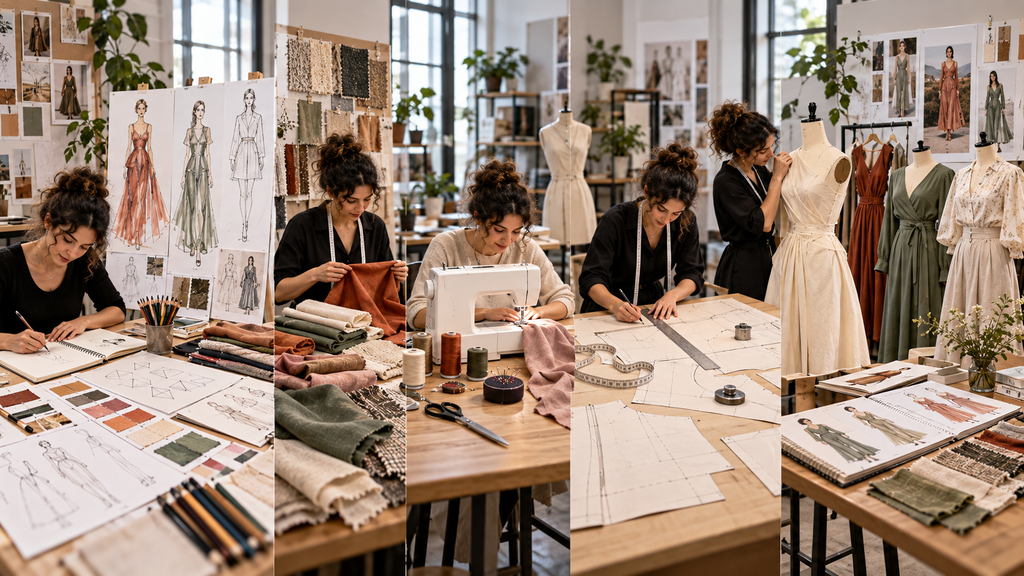
A simple progression can prevent you from becoming overwhelmed:
Step 1: Learn line, shape, colour, texture, proportion and balance.
Step 2: Practise basic fashion illustration.
Step 3: Study fabrics by comparing their weight, texture, stretch and drape.
Step 4: Learn basic sewing and simple seams.
Step 5: Understand basic pattern pieces.
Step 6: Make a simple garment such as a skirt or top.
Step 7: Create a small design project or mini collection.
You do not need to master everything before moving forward.
How Do You Know If Fashion Designing Is Right for You?
You may enjoy fashion design if you like:
- Creating things
- Clothing and fabrics
- Drawing or visual work
- Problem solving
- Research
- Experimenting
- Working with your hands
- Developing ideas
- Improving something through repeated attempts
You should also be comfortable receiving criticism and revising your work.
Your first idea is rarely your final idea.
Can You Learn Fashion Design at Home?
Yes, many fundamentals can be learned independently.
At home, you can practise:
- Sketching
- Colour theory
- Mood boards
- Fashion research
- Fabric study
- Basic sewing
- Hand stitching
- Digital illustration
- Basic patterns
Structured classes become more useful when you need specialist equipment, fitting feedback, advanced construction, pattern correction, draping support or portfolio reviews.
A combination of self-practice and structured learning can work well for beginners.
Frequently Asked Questions
Is fashion designing hard for beginners?
It can initially feel challenging because you are learning several creative and technical skills together. However, the fundamentals can be learned gradually.
Can I study fashion design if I cannot draw?
Yes. Drawing is a skill that improves with practice. You do not need professional-level drawing ability before starting.
Is sewing compulsory?
Understanding sewing and garment construction is valuable, although not every fashion career requires you to sew professionally.
Do I need maths for fashion designing?
Basic maths is useful for measurements, patterns, fabric calculations and costing. Advanced mathematics is generally unnecessary for beginner-level fashion design.
Can I become a fashion designer without a degree?
There is no single route into every fashion career. Skills, portfolio quality, technical knowledge, qualifications and experience may all matter depending on the role.
Conclusion
So, is fashion designing hard?
Sometimes.
Pattern making can initially be confusing. Sewing requires repetition. Fabric behaviour takes time to understand. Your first illustrations may not look professional, and some ideas will not work when you try to construct them.
That is part of learning.
Fashion design becomes much easier when you stop expecting yourself to master everything immediately.
Start with the basics. Practise one skill at a time. Make real projects. Ask for feedback. Then gradually attempt more difficult work.
You do not need to begin as a designer.
You begin as a student, and the skills develop from there.