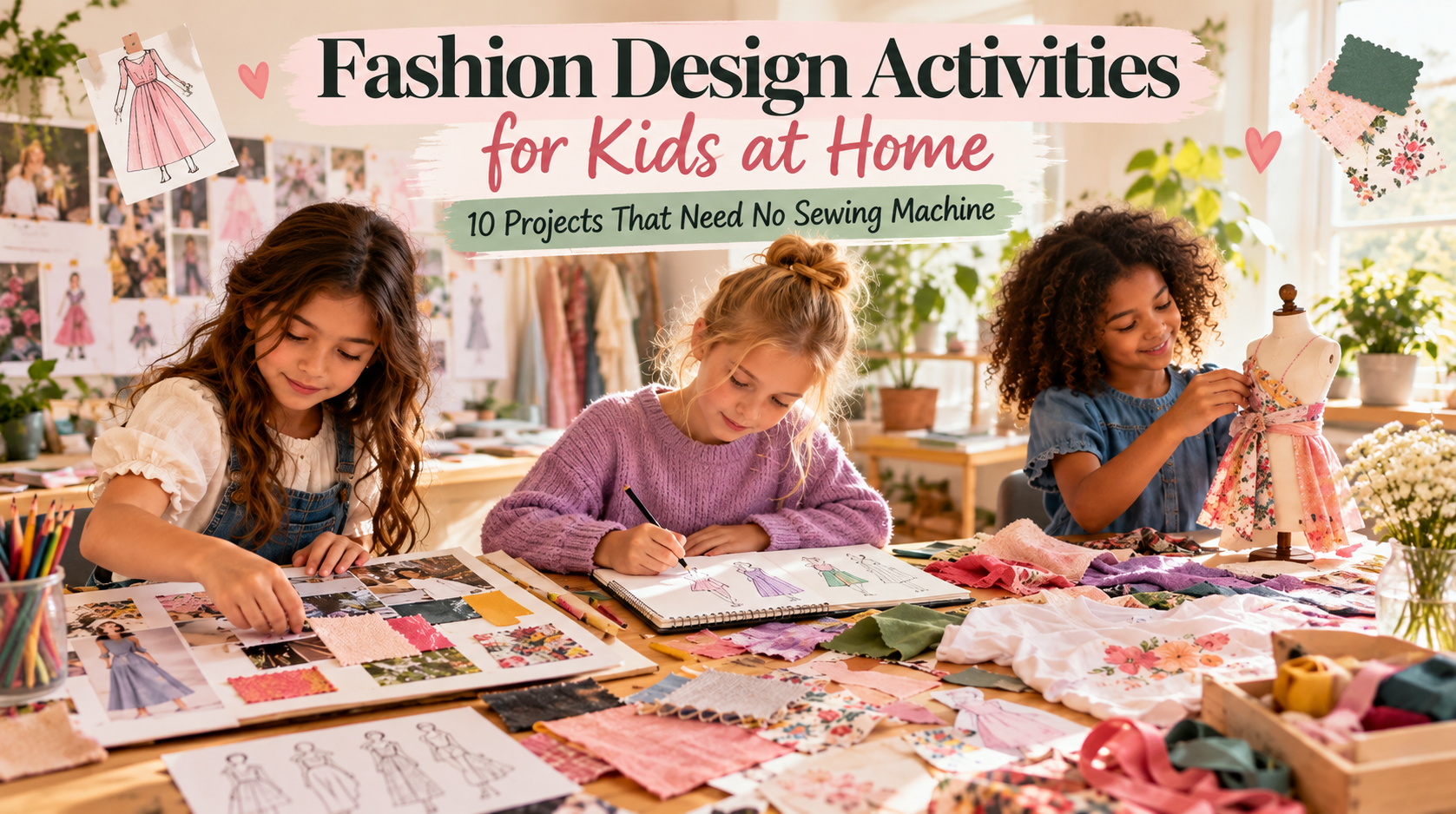
Fashion design does not have to begin with a sewing machine.
Children can start learning how designers think by experimenting with colours, fabrics, outfits, prints and old clothes. Most beginner activities only require paper, pencils, scissors, glue and a few fabric scraps.
Here are 10 fashion design activities for kids that can be done at home with simple materials.
Before You Start: Keep It Simple and Safe
You do not need professional fashion equipment.
A basic activity box can include:
- Paper and pencils
- Colouring pencils or washable markers
- Old magazines
- Child-safe scissors
- Glue sticks
- Fabric scraps
- Ribbon and yarn
- Old T-shirts
- Cardboard
- Fabric markers
- Ruler
Younger children should be supervised when using scissors, adhesives or small decorative materials. These projects avoid sewing machines, hot glue guns and complicated equipment.
1. Create a Fashion Mood Board
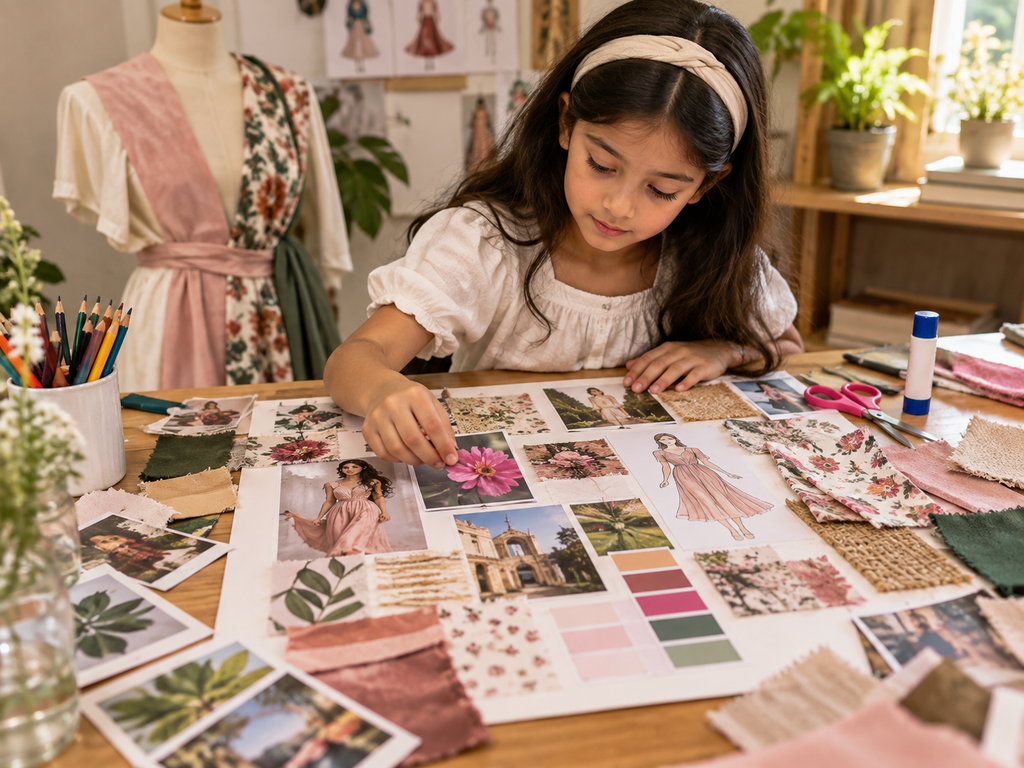
Best for: Inspiration, colour and personal style
Time: 30–60 minutes
Fashion collections often begin with an idea. A mood board helps children bring those ideas together visually.
Choose a theme such as nature, space, flowers, sports, summer or futuristic fashion. Then collect images, colours, textures and words connected to it.
How to do it
- Choose a theme.
- Find suitable pictures and textures.
- Select three to five main colours.
- Arrange everything on paper.
- Glue the pieces down.
- Give the collection a name.
The aim is to understand how different visual ideas can connect, not simply to create a perfect collage.
2. Design Three Outfits Around One Theme
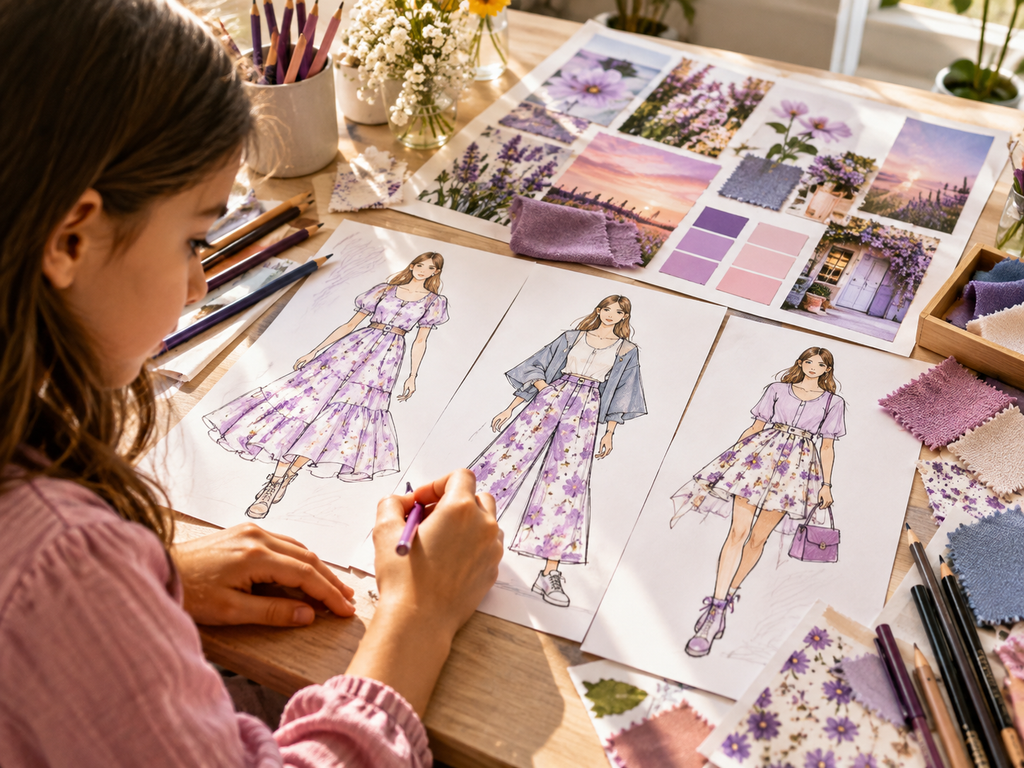
Best for: Fashion illustration and idea development
Time: 30–45 minutes
Turn the mood board into a mini fashion collection.
Ask the child to design three outfits connected by a common theme, colour, print or shape.
For each design, ask:
- Who would wear it?
- Where would they wear it?
- What fabric would work?
- What connects the three outfits?
This encourages children to think about the purpose behind a design instead of focusing only on decoration.
3. Make a Paper Doll Wardrobe
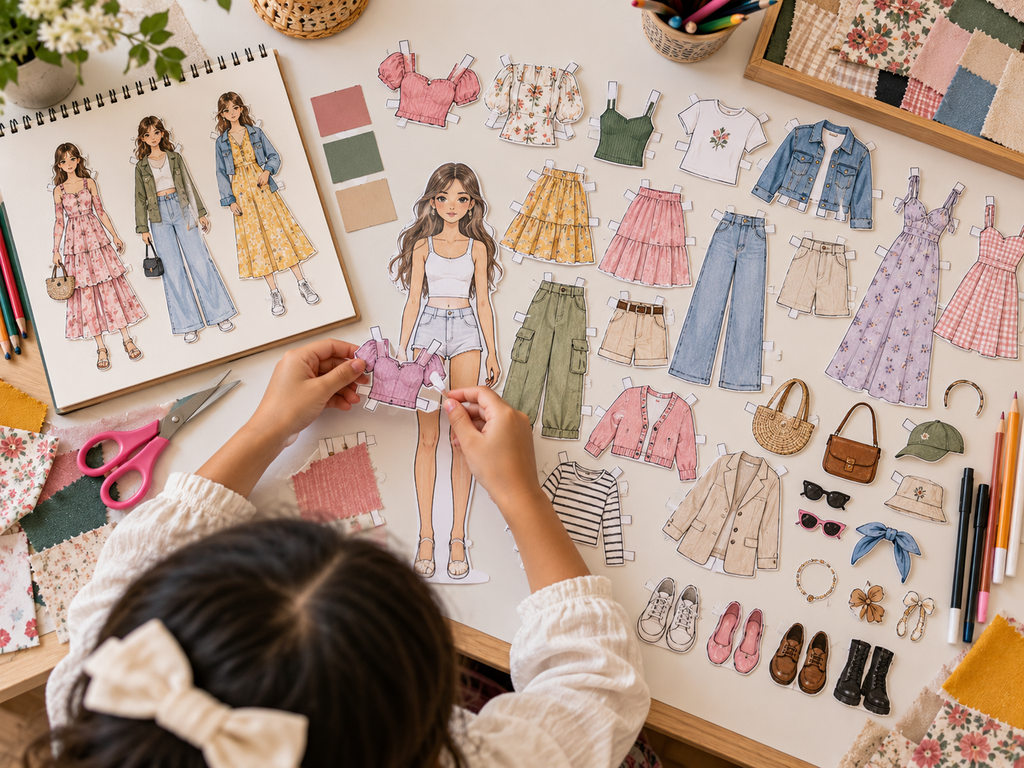
Best for: Garment shapes and styling
Time: About 45 minutes
Draw a simple figure on card and cut it out. Place paper over the figure and design clothes that fit around it.
Children can create tops, trousers, skirts, dresses, jackets, shoes and accessories.
For an extra challenge, create a small capsule wardrobe with:
- 2 tops
- 2 bottoms
- 1 jacket
- 1 dress
- 2 accessories
Then mix the pieces to create different outfits.
It is a simple way to introduce the idea of designing a coordinated wardrobe rather than individual garments.
4. Start a Fabric Swatch Journal
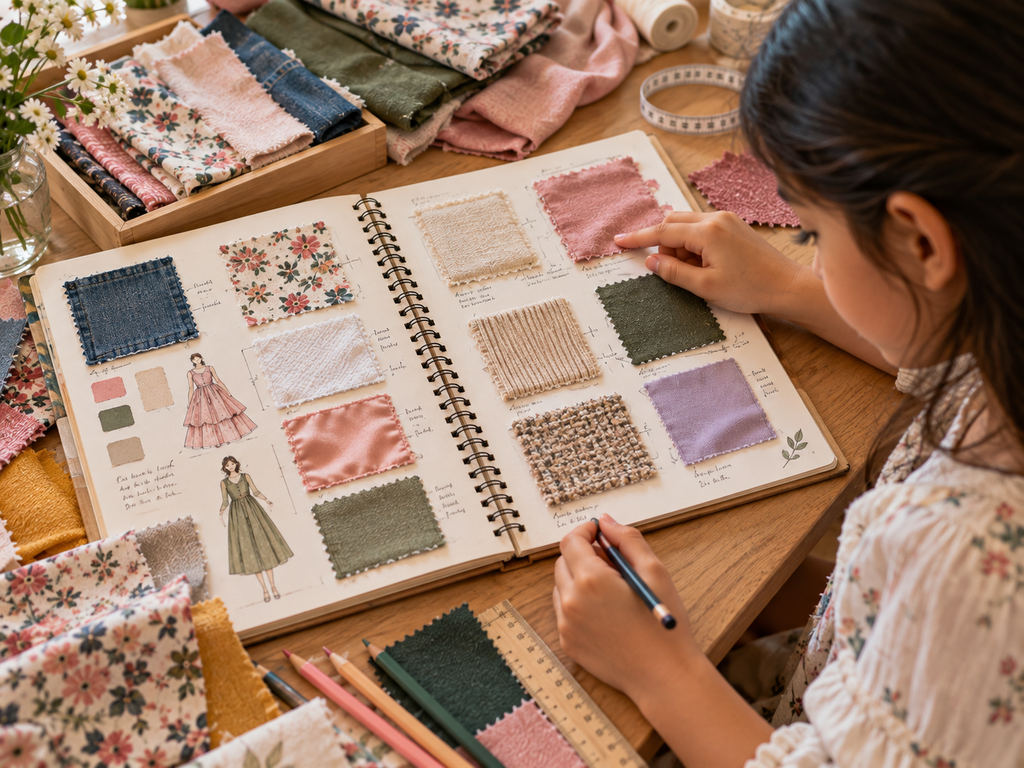
Best for: Learning about textiles
Time: Flexible
Collect small pieces of fabric from old clothes or leftover material and glue them into a notebook.
For each fabric, describe:
- How does it feel?
- Is it smooth or textured?
- Does it stretch?
- Is it heavy or lightweight?
- What could you make from it?
- What colours does it contain?
Technical vocabulary is not necessary. Words such as soft, rough, shiny, stretchy, thick and lightweight are enough for beginners.
Over time, children can also start recognising fabrics such as cotton, denim, linen, satin and jersey.
5. Design Your Own Fabric Print
Best for: Colour, pattern and textile design
Time: 30–60 minutes
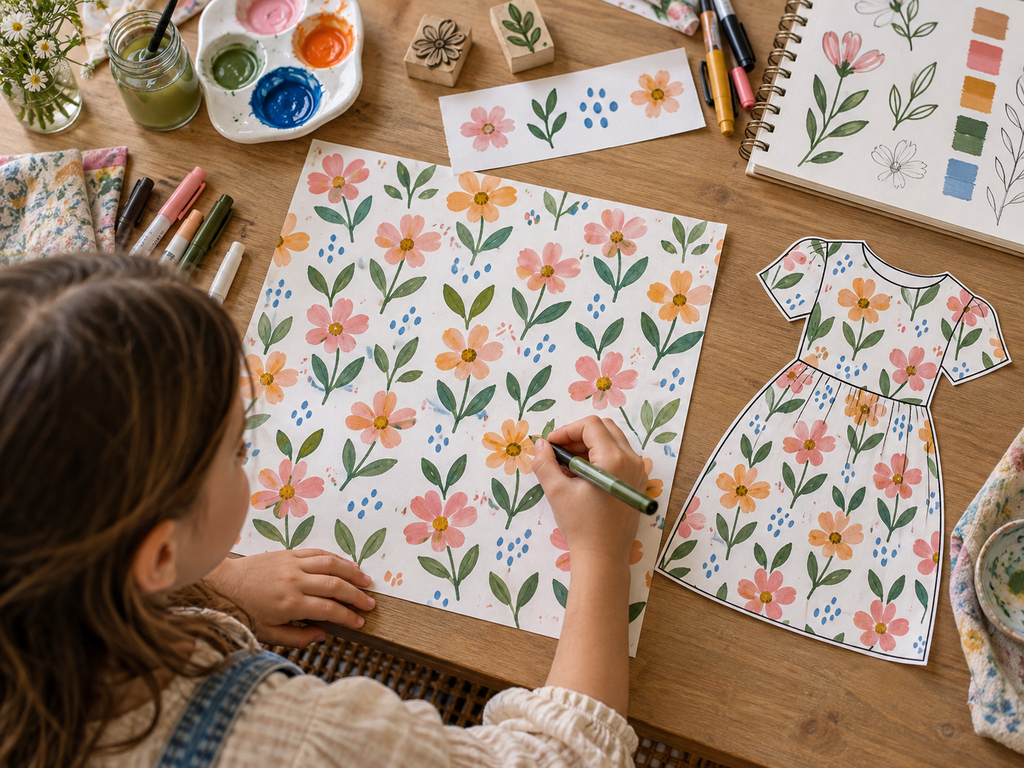
Ask the child to create a repeating print using flowers, stars, fruit, animals, geometric shapes or abstract marks.
Start with one motif and repeat it across the page.
Experiment with changing:
- Colour
- Size
- Direction
- Spacing
The finished print can even be cut into the shape of a dress, shirt or trousers to imagine how it might look on clothing.
6. Make a No-Sew Fabric Fashion Collage
Best for: Fabric combinations
Time: 30–45 minutes
Instead of colouring a fashion illustration, dress it using real materials.
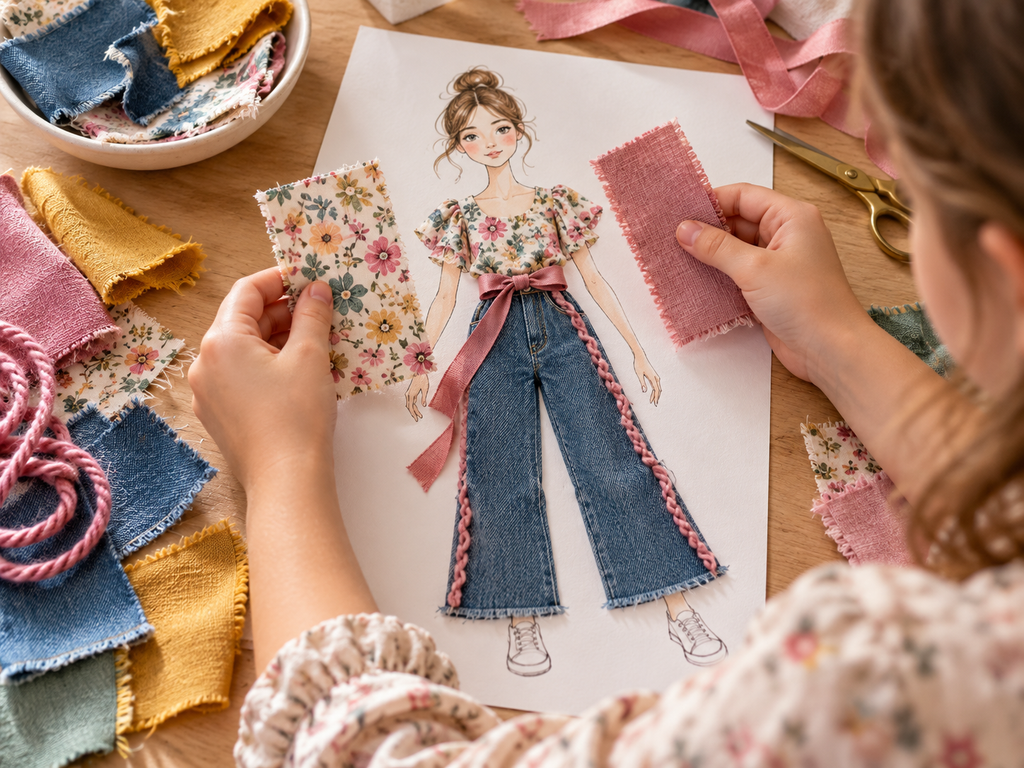
Draw or print a simple fashion figure and use fabric scraps, ribbon and yarn to create the outfit.
For example:
- Denim for trousers
- Floral fabric for a dress
- Ribbon for a belt
- Yarn for trim
Ask which fabrics work well together, which should be the main material and whether they suit the garment.
This turns fashion into a decision-making activity rather than simple colouring.
7. Redesign an Old T-Shirt
Best for: Customisation and upcycling
Time: About 45 minutes
An old plain T-shirt can become a blank fashion canvas.
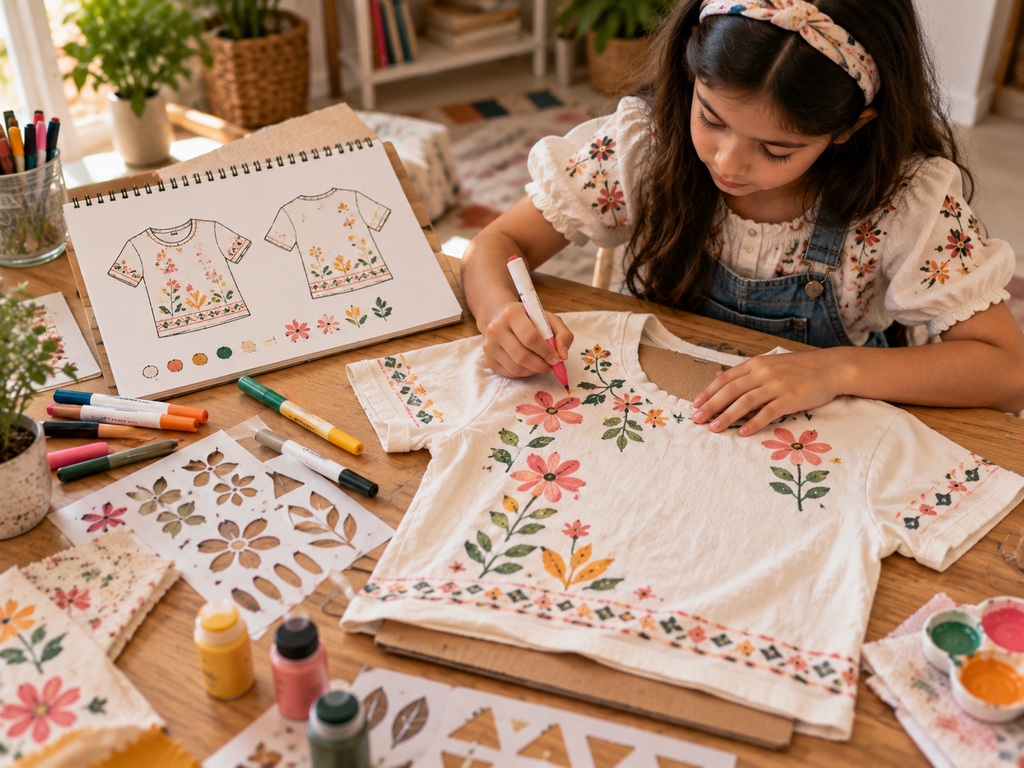
Before decorating it, ask the child to sketch the front and back of the design on paper.
Then use child-safe fabric markers, paint or stencils to add:
- Initials
- Repeating patterns
- Illustrations
- Sleeve borders
- Chest graphics
- Back designs
Place cardboard inside the shirt before decorating to prevent colour from transferring.
This also teaches an important design habit:
Plan first, make second.
8. Make a No-Sew T-Shirt Tote Bag
Best for: Upcycling
Time: 30–45 minutes
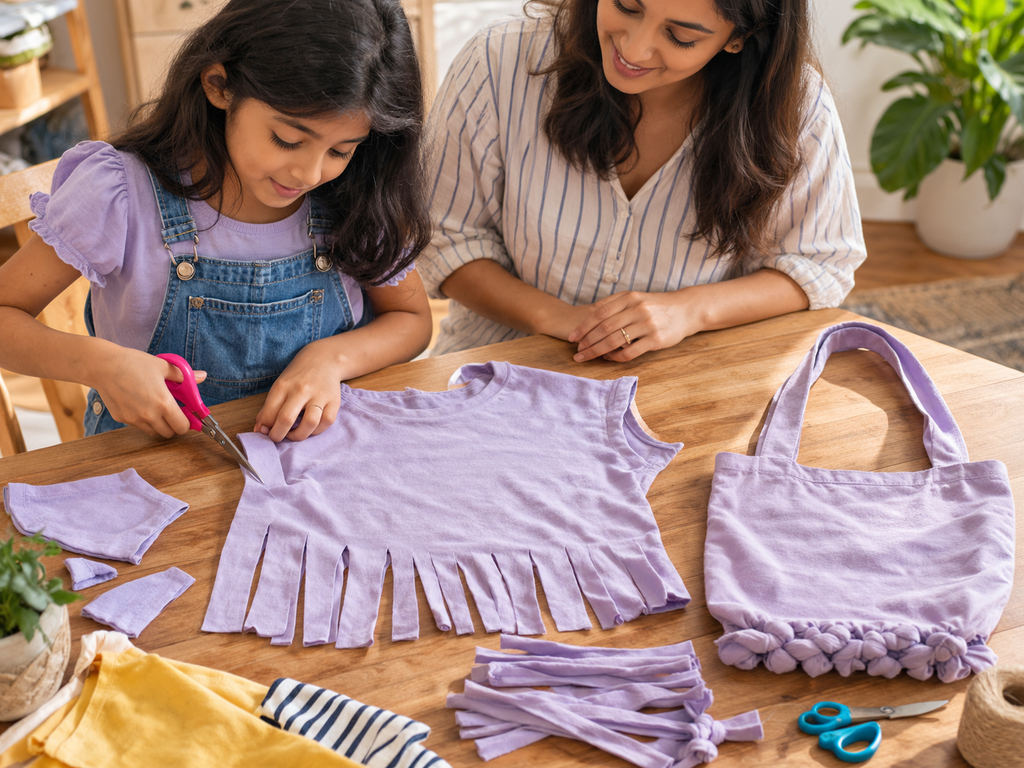
An old T-shirt can also be turned into a simple bag.
- Lay the shirt flat.
- Remove the sleeves.
- Enlarge the neckline to create the opening.
- Cut strips along the bottom.
- Tie matching front and back strips together.
- Turn the bag right side out.
Adults should help younger children with cutting and check that the knots are secure.
The activity introduces upcycling — redesigning something that already exists rather than throwing it away.
9. Try a Mini Draping Challenge
Best for: Understanding shape and volume
Time: 30–60 minutes
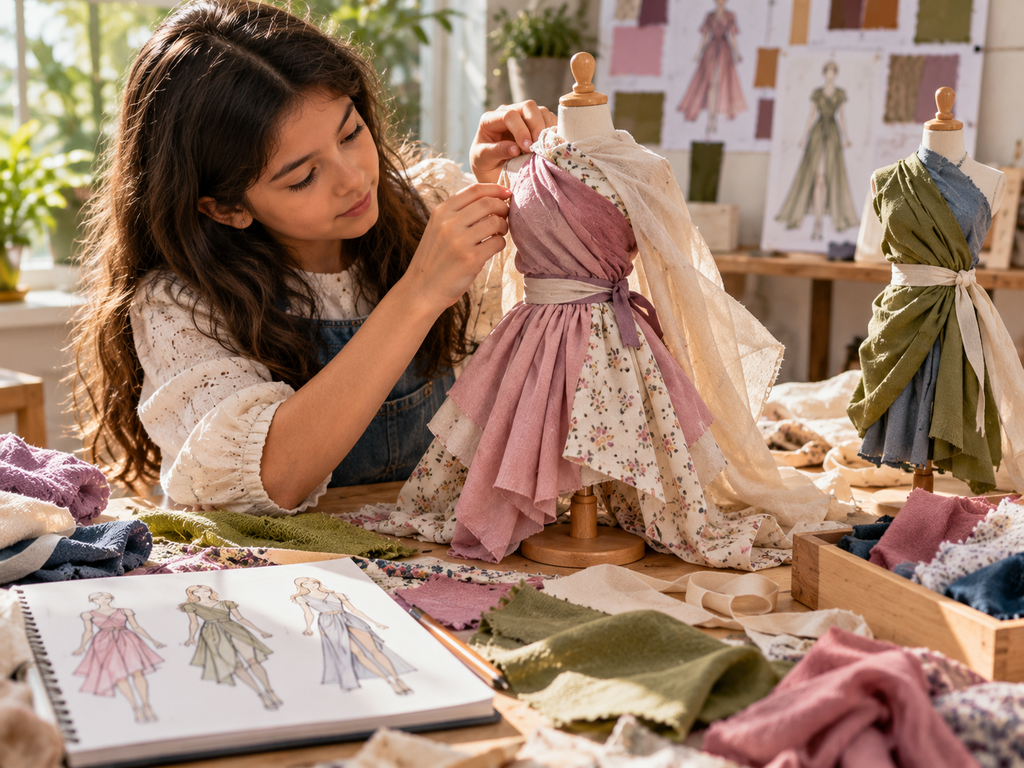
Draping involves arranging fabric directly around a form.
Children can try a simple version using a doll, small mannequin or cardboard body shape.
Experiment with:
- Wrapping
- Folding
- Gathering
- Layering fabrics
- Creating capes
- Adding ribbon belts
Use removable tape or ties rather than pins for younger children.
Sketching helps children imagine a garment, while draping lets them immediately see how fabric behaves in three dimensions.
10. Create a Five-Look Fashion Collection
Best for: Bringing everything together
Time: Around one hour or several shorter sessions
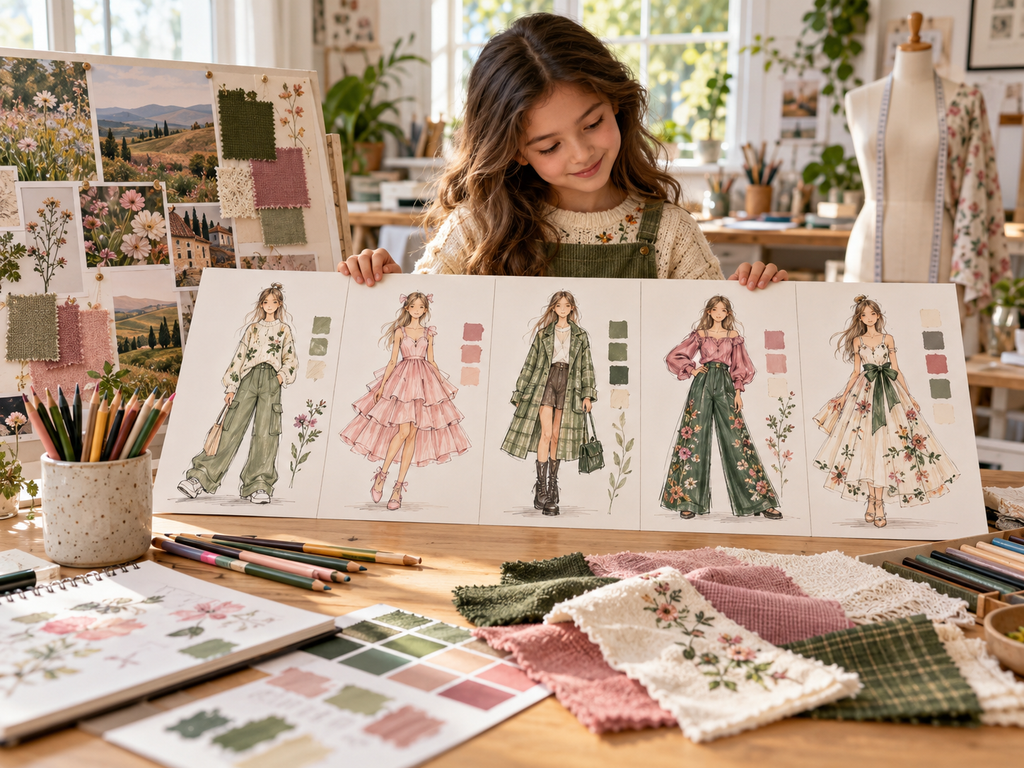
Finish with a project that feels more like a real fashion design brief.
Decide on:
Theme: What inspired the collection?
Customer: Who is it designed for?
Occasion: Where would the clothes be worn?
Colour palette: Choose three to five main colours.
Fabric: What materials could work?
Then create five connected outfits, such as:
- Casual look
- Party outfit
- Jacket or outerwear look
- Statement outfit
- Favourite final design
Give the collection a name and present all five looks together.
The original projects progress from inspiration and illustration to textiles, customisation, draping and finally collection development.
What Can Kids Learn From Fashion Design?
Fashion activities develop more than drawing skills.
Creative Problem Solving
Children make decisions about colours, materials, shapes and how to improve ideas that do not work initially.
Observation
Handling fabrics encourages them to notice texture, weight, stretch, pattern and colour.
Visual Communication
A fashion sketch does not need to be perfect. Its purpose is to communicate an idea.
Fine Motor Skills
Drawing, cutting, folding and arranging materials require controlled hand movements.
Understanding the Design Process
Most importantly, children begin to experience the basic creative process:
Inspiration → Idea → Experiment → Make → Review → Improve
That is much closer to real design thinking than simply colouring a pre-drawn outfit.
How Parents Can Encourage Creativity
Try not to correct every unusual design choice.
Instead of saying:
“Those colours don’t match.”
Ask:
“Why did you choose those colours?”
Instead of:
“The dress should be longer.”
Ask:
“What would happen if you made it longer?”
The goal is experimentation, not perfect fashion illustrations.
An impractical sleeve or unusual colour combination can still help a child think about why a design works — or how it could be improved.
Do Kids Need to Know How to Draw?
No.
Drawing is only one way to communicate fashion ideas.
Children can also experiment through:
- Fabric
- Collage
- Paper
- Draping
- Mood boards
- Printing
- Upcycling
- Colour experiments
Children who are uncomfortable drawing figures can use a printed fashion template or concentrate only on designing the garment.
Design thinking matters more than perfect illustration.
Frequently Asked Questions
Can kids learn fashion design without sewing?
Yes. Children can learn colour, illustration, textiles, draping, collection planning and garment concepts before learning to sew.
What is the easiest fashion activity for beginners?
A fashion mood board or three-outfit challenge is a good starting point because both require very little equipment.
What materials do kids need?
Paper, pencils, colouring materials, scissors, glue and fabric scraps are enough for most beginner projects.
Can old clothes be used?
Yes. Old clothes are useful for customisation, studying garment details and learning about upcycling. Adults should supervise difficult cutting.
Can these activities be used in a class?
Yes. They can be adapted for school projects, workshops, group activities or home learning.
Is a sewing machine necessary?
No. A sewing machine becomes useful when children begin constructing more advanced garments, but it is not necessary for learning the basic design process.
Conclusion
Fashion design for kids can begin with little more than paper, pencils and a few pieces of fabric.
Mood boards teach inspiration, fabric journals introduce textiles, paper wardrobes develop an understanding of garment shapes, draping explores volume, and a mini collection brings several skills together.
No sewing machine is required.
The aim is not to create a perfect garment immediately. It is to encourage children to notice, imagine, experiment, make and improve their own ideas.