
A fashion sketch may show the shape, colour and overall look of a garment, but it does not tell you exactly how to cut the fabric.
That is where pattern making comes in.
Before most garments are sewn, their shapes are worked out as separate flat pieces. A shirt, for example, may need front and back pieces, sleeves, cuffs, a collar and other components. Each piece has to be shaped and sized so that when they are cut from fabric and sewn together, they form the intended garment.
This process is known as pattern making.
It is one of the practical links between fashion design and garment construction, and learning the basics can help a designer understand fit, proportion and how a design actually comes together.
What Is Pattern Making in Fashion?
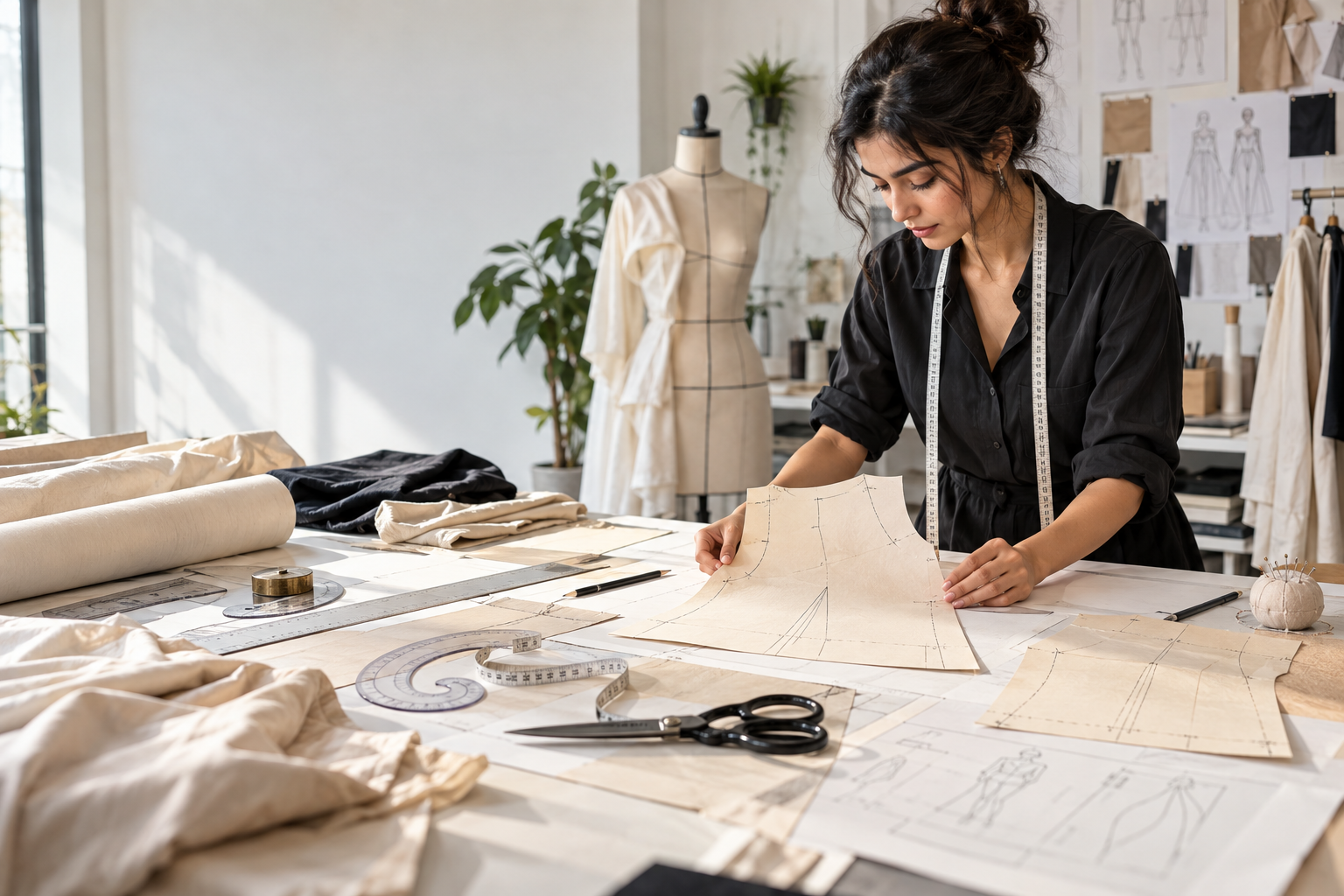
Pattern making is the process of creating two-dimensional templates, called patterns, for the individual pieces of a garment.
A pattern may include details such as:
- Grainline
- Darts
- Notches
- Fold lines
- Seam allowance
- Pocket and button placement
- Cutting instructions
- Size information
Pattern making connects fashion design with garment construction and helps designers understand fit, proportion and structure.
Why Is Pattern Making Important?
A garment that looks good in a sketch will not necessarily fit correctly on the body. Pattern making helps translate a two-dimensional design into a three-dimensional garment.
A pattern maker may need to consider:
- Bust and waist measurements
- Shoulder width
- Neckline
- Armhole shape
- Sleeve dimensions
- Garment ease
- Seam placement
A change to one pattern piece can affect another. For example, changing the armhole may require a sleeve adjustment.
What Is a Fashion Pattern?
A pattern represents one section of a garment. A shirt, for example, may require:
| Pattern Piece | Purpose |
| Front bodice | Forms the front |
| Back bodice | Forms the back |
| Sleeve | Forms the sleeve |
| Collar | Creates the collar |
| Cuff | Forms the cuff |
| Facing | Finishes openings and edges |
The number of pieces depends on the garment design.
What Is a Block or Sloper?
A block, also called a sloper, is a basic foundation pattern created from specific measurements. It has minimal styling and acts as a starting point for different garment designs.
Common blocks include:
- Bodice
- Skirt
- Sleeve
- Trouser
- Dress
A single bodice block can be modified into a blouse, shirt, crop top, dress or jacket.
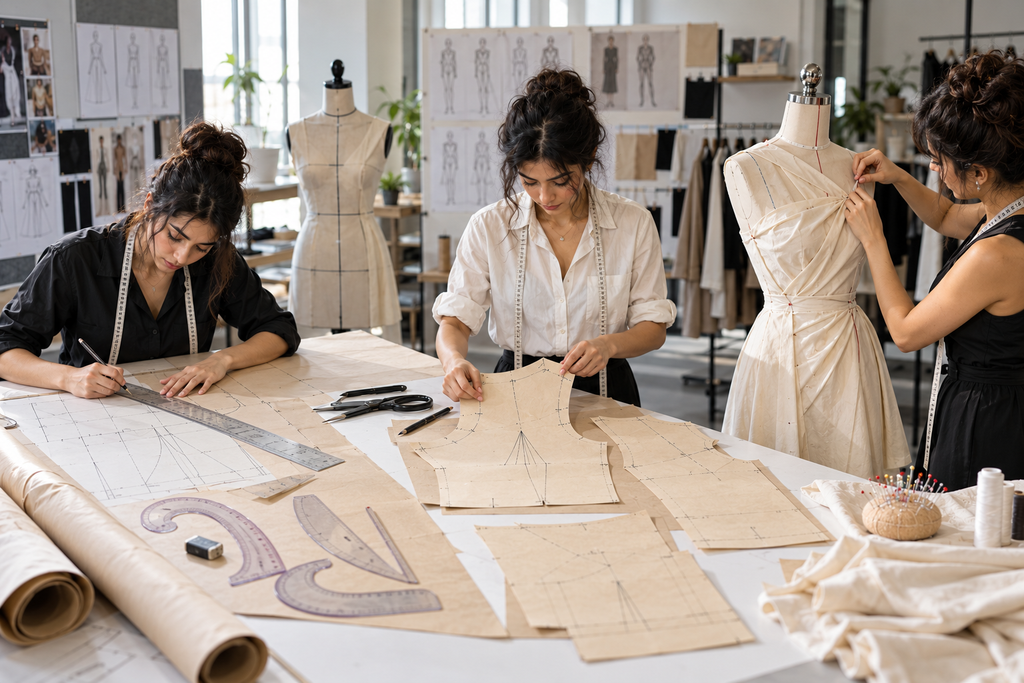
Main Methods of Pattern Making
1. Pattern Drafting
Pattern drafting creates a pattern from body measurements using drafting principles. Measurements such as bust, waist, hip, shoulder and length are used to develop the basic shape.
2. Flat Pattern Making
Flat pattern making starts with an existing block and modifies it to create a new style.
Common techniques include:
Slash and spread: Cutting and opening sections to add fullness or change shape.
Pivoting: Moving a dart or shaping element while maintaining the basic fit.
Dart manipulation: Repositioning darts to create different design effects.
3. Draping
Draping develops a garment directly on a dress form using fabric such as muslin or calico. The fabric is pinned, folded and shaped to create the desired silhouette before being transferred into a pattern.
Draping is particularly useful for:
- Pleats
- Cowls
- Draped garments
- Asymmetrical designs
- Sculptural silhouettes
- Experimental fashion
Pattern Drafting vs Draping
| Pattern Drafting | Draping |
| Starts with measurements | Starts with fabric |
| Mainly two-dimensional | Three-dimensional |
| Useful for structured designs | Useful for fluid and experimental designs |
| Uses paper and drafting tools | Uses fabric, pins and a dress form |
Both methods can be useful depending on the garment and design.
Essential Pattern Making Tools
Beginners can start with a simple set of tools:
- Measuring tape
- Pattern paper
- Pattern ruler
- French curve
- Hip curve
- Set square
- Pencil and eraser
- Paper scissors
- Tracing wheel
- Pins
- Dress form
These tools help with accurate drafting, cutting, fitting and draping.
Basic Pattern Making Terms
Grainline: Shows how a pattern piece should be positioned on the fabric.
Dart: Removes a controlled amount of fabric to create shaping around areas such as the bust, waist or hips.
Seam allowance: Extra material outside the stitching line used to join garment pieces.
Notch: A small reference mark used to match pattern pieces during construction.
Ease: The difference between body measurements and finished garment measurements. It provides movement and helps create the desired silhouette.
Toile: A test garment made from inexpensive fabric to check fit, balance, proportion and construction before using final fabric.
How Is a Fashion Pattern Made?
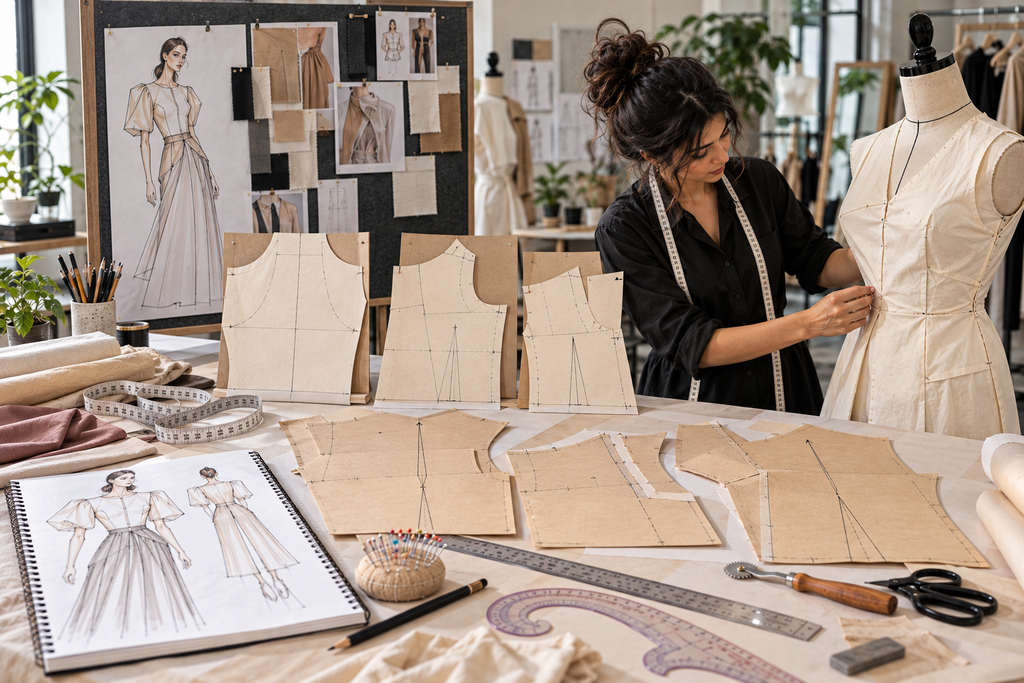
A basic pattern-making process usually follows these steps:
1. Study the design
Identify its components, including sleeves, collars, seams, darts and closures.
2. Take measurements
Measure areas such as the bust, waist, hip, shoulder, sleeve and garment length.
3. Create or select a block
Start with a suitable foundation pattern.
4. Develop the design
Modify the block by changing the neckline, darts, sleeves, fullness or seam lines.
5. Add pattern markings
Include grainline, notches, pattern names, cutting information and seam allowance.
6. Make a toile
Create a test garment from inexpensive fabric.
7. Check the fit
Look for pulling, tight areas, excess fabric, uneven hems, poor balance or incorrect seam placement.
8. Correct the pattern
Transfer fitting changes back to the pattern.
9. Prepare the final pattern
Create a clean version with all required information.
The process may need to be repeated until the fit and construction are correct.
What Is Digital Pattern Making?
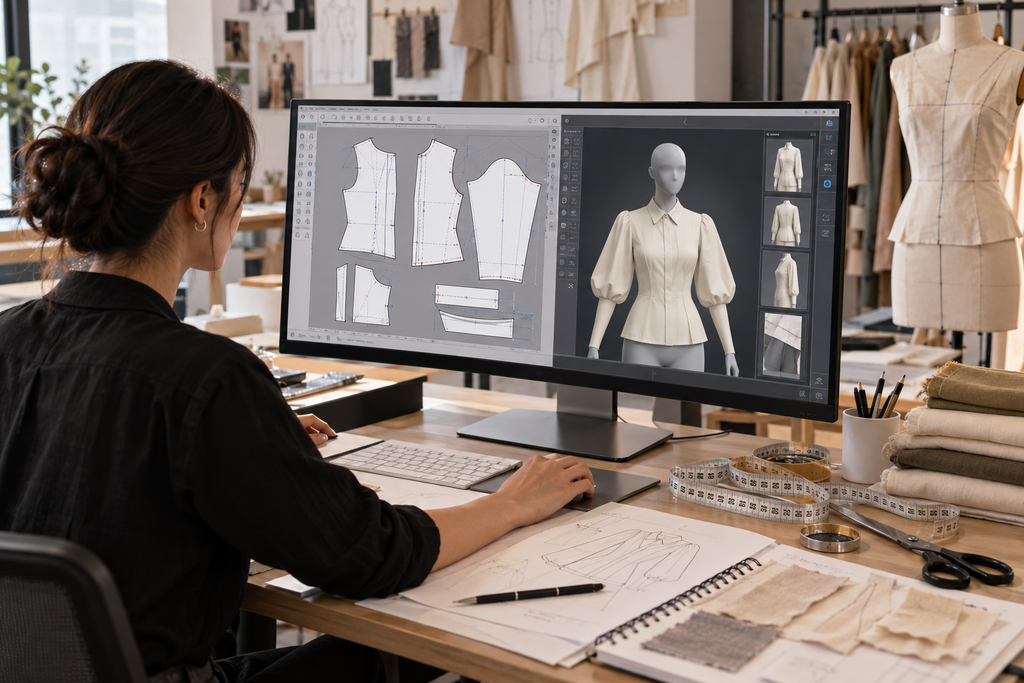
Pattern making can be done digitally using specialised fashion software.
Digital tools can help designers:
- Draft and edit patterns
- Store pattern libraries
- Grade patterns into different sizes
- Arrange pattern pieces
- Visualise garments in 3D
- Share digital pattern files
Software such as CLO can connect two-dimensional patterns with three-dimensional garment visualisation.
However, digital tools do not replace the fundamentals of pattern making. Understanding fit, measurements, grain, darts, balance and construction is still essential.
Pattern Making vs Sewing
Pattern making and sewing are related but different skills.
Pattern making determines the shapes that need to be cut.
Sewing joins those pieces to construct the garment.
Learning both skills can help fashion designers understand how creative ideas translate into actual garments.
Common Beginner Mistakes
Beginners often make mistakes such as:
Inaccurate measurements: Small errors can affect the fit of multiple pieces.
Ignoring grainline: Incorrect grain placement can affect how the garment hangs.
Forgetting seam allowance: Always check whether it is already included in the pattern.
Changing connected pieces independently: Alterations to one piece may require changes to another.
Skipping the toile: Testing the pattern first can prevent expensive fitting problems.
Focusing only on measurements: Good fit also depends on balance, movement, proportions and fabric behaviour.
Is Pattern Making Difficult to Learn?
Pattern making involves measurement, spatial thinking and practice, so it takes time to master. Beginners should start with simple garments and gradually increase complexity.
A useful progression is:
Basic Skirt → Bodice → Sleeve → Simple Dress → Shirt → Trousers → Complex Garments
Starting with basic blocks makes it easier to understand how pattern changes affect the final garment.
Why Should Fashion Design Students Learn Pattern Making?
Pattern-making knowledge helps students connect creative ideas with practical garment construction.
It can help them:
- Understand garment structure
- Improve fit
- Develop original designs
- Communicate with pattern makers
- Understand production limitations
- Experiment with silhouettes and proportions
- Judge whether a design can actually be constructed
A designer does not have to become a professional pattern maker, but understanding patterns can lead to better and more practical design decisions.
Frequently Asked Questions
What is pattern making in simple words?
Pattern making is creating templates for the different pieces of a garment so they can be cut from fabric and sewn together.
What is the difference between pattern making and pattern drafting?
Pattern making is the overall process of developing garment patterns, while pattern drafting is one method of creating them from measurements.
What is a basic pattern?
A basic pattern, or block/sloper, is a foundation pattern that can be modified to create different garment styles.
What are the main methods of pattern making?
The main methods are pattern drafting, flat pattern making and draping. Digital pattern making is also widely used.
Do fashion designers need to know pattern making?
Not every designer needs to become a specialist, but understanding pattern making helps with fit, proportions, construction and design development.
Can I learn pattern making without knowing how to sew?
Yes, you can learn the theory without advanced sewing skills, but basic sewing knowledge becomes increasingly useful when testing and fitting garments.
Is pattern making done by hand or computer?
Both. Patterns can be created manually on paper or digitally using CAD and 3D fashion software.
Conclusion
Pattern making transforms a fashion idea into a garment that can actually be cut and constructed.
By learning pattern drafting, flat pattern making and draping, designers can better understand fit, structure, proportions and garment construction. Beginners should start with basic blocks, create test garments, study the fit and gradually move toward more complex designs.
With practice, pattern making becomes more than a technical process—it becomes an important part of fashion design.