Picture a four-year-old at a birthday party. In the space of an hour she’ll climb a slide, spill juice down her front, sit cross-legged on concrete, get picked up under the arms by three different relatives, and try to take her own jacket off without asking for help. Whatever she’s wearing has to survive all of that and still look good in the photos afterward.
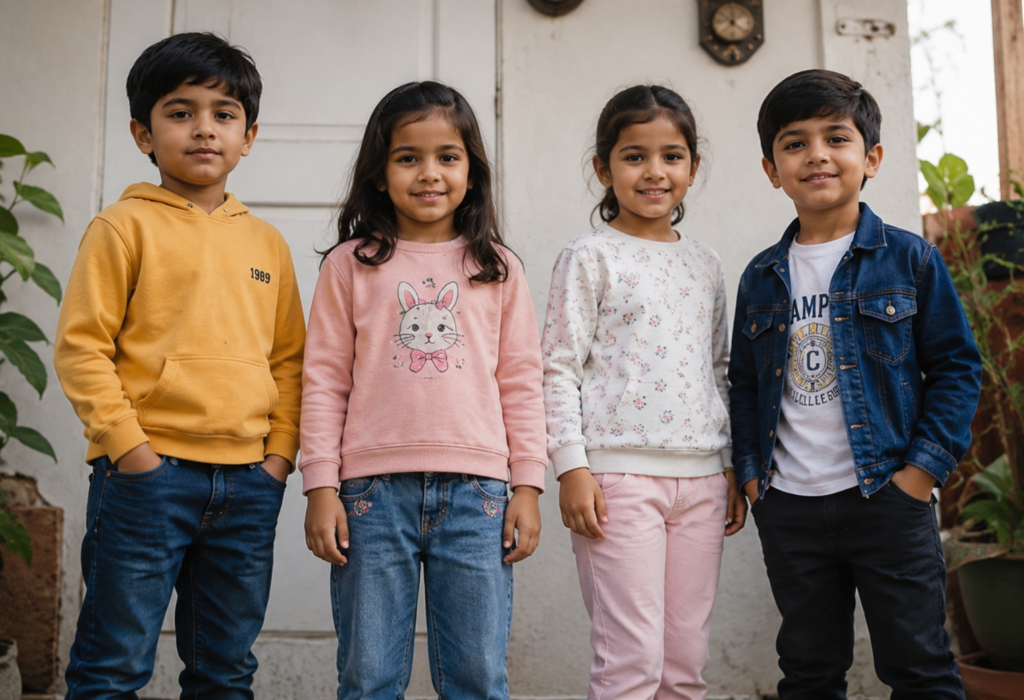
That’s the actual brief behind almost every piece of children’s clothing on a store shelf. It’s a brief adult fashion almost never has to answer, and it’s why kidswear design deserves to be treated as its own discipline rather than a smaller version of grown-up design.
Designing for Two Customers with One Garment
Here’s the part that trips up a lot of newcomers: a kidswear designer is never really designing for one customer. There’s the child, who wants to like the print, feel comfortable, and forget the clothes are even there once they start playing. And there’s the parent, who’s silently running a checklist – will this survive the washing machine forty times, does the size work for a growth spurt, is it safe, is it worth the money.
A garment that wins over the kid but fails the parent’s checklist doesn’t sell. A garment that satisfies every parental concern but bores the child doesn’t get worn happily. Good kidswear design is the intersection of both, and most of a designer’s judgment calls trace back to balancing these two audiences against each other.
What Does a Kidswear Designer Actually Do?
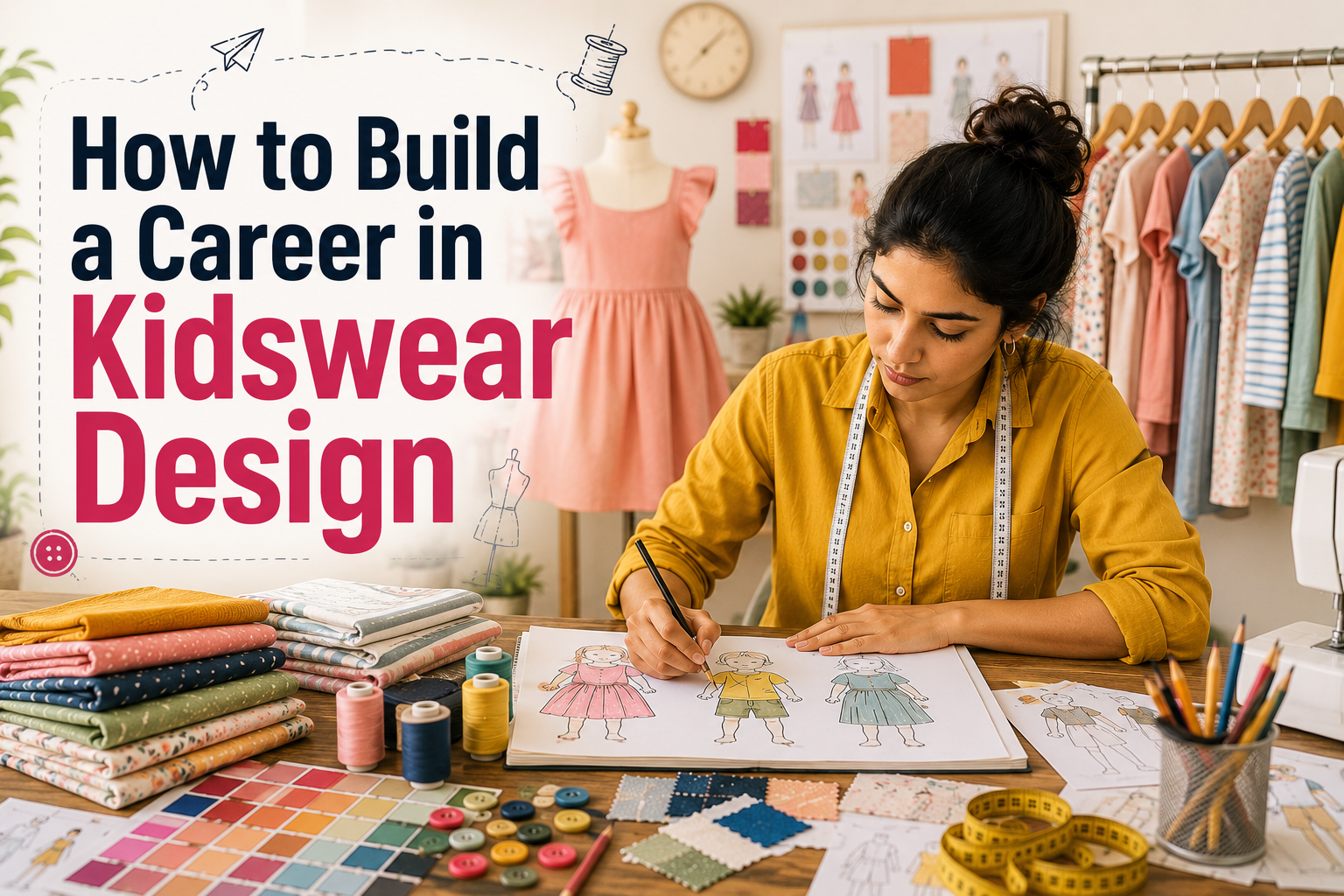
Sketching is a small slice of the job, not the center of it. A more honest week looks like:
- Digging into what’s trending for the season and what similar brands are already doing
- Turning a concept into a mood board the rest of the team can react to
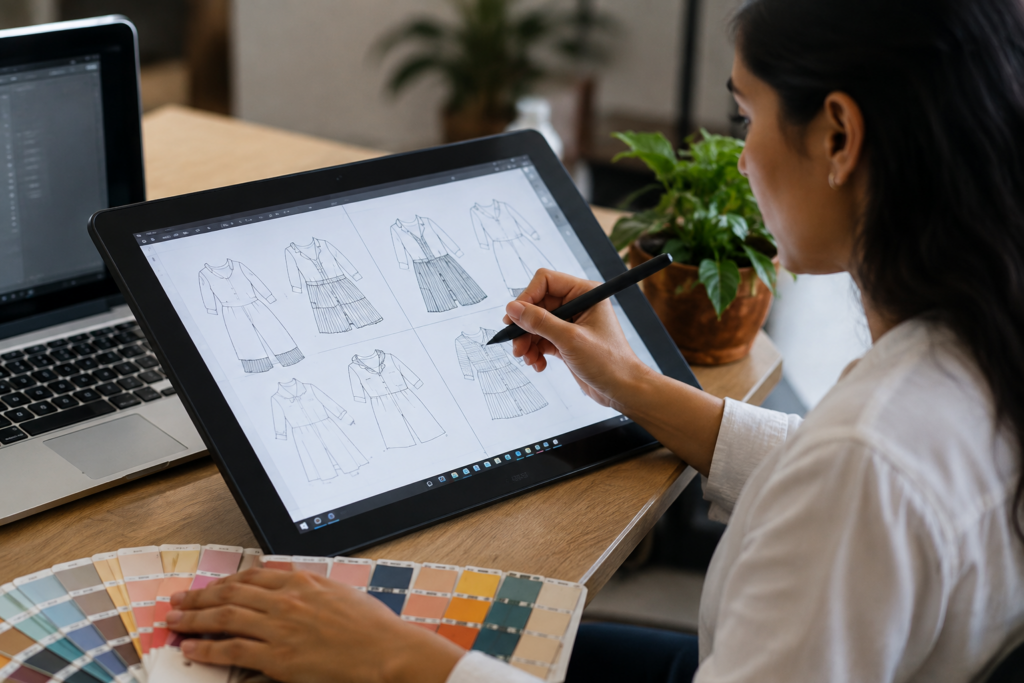
- Sketching by hand or in Illustrator, then converting the strongest ideas into technical flats and a full spec sheet
- Choosing fabric, trim, and closures – with cost and durability in mind, not just look
- Sitting with a pattern maker while a sample gets fitted, then marking up what needs to change
- Checking a finished collection against comfort and safety requirements before it ever reaches a factory floor
Designers rarely work garment by garment. Most build entire collections at once – a full back-to-school lineup for ages 6–10, say – because retailers buy in ranges, not single items.
Designing for Growing, Active Kids
Adult design has to account for how someone moves. Kidswear has to account for how someone moves and grows, sometimes within the same season. A few questions guide almost every fit decision:
Can the child get this on and off without help? Does the neckline stretch enough for an independent four-year-old who refuses assistance? Is there room built into the waistband for a growth spurt between now and the end of the season? Does anything restrict the specific way small kids sit – cross-legged, kneeling, folded in half over a coloring book?
These aren’t afterthoughts bolted on at the end. They shape the pattern from the first draft.
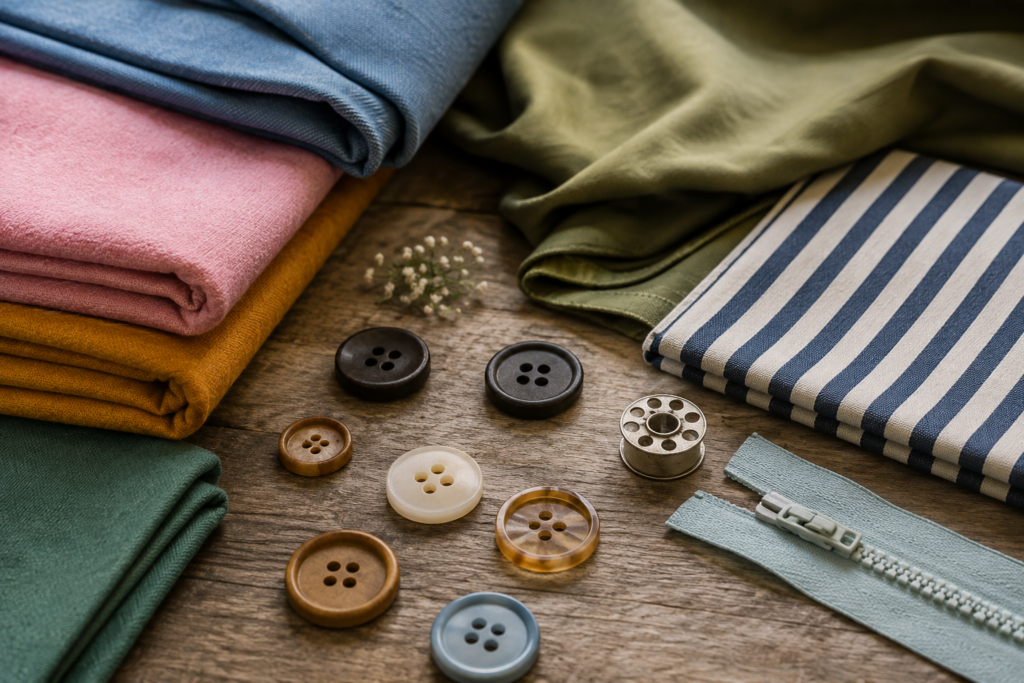
Choosing Fabrics That Can Keep Up with Kids
| Fabric | Where It Shows Up | Why Designers Reach for It |
| Cotton | Everyday basics | Soft, breathable, holds up in the wash |
| Organic cotton | Higher-end lines | Same comfort, lighter environmental footprint |
| Jersey knit | Tees, leggings | Stretches and recovers well |
| Denim | Bottoms, jackets | Tough enough for daily wear |
| Fleece | Winter pieces | Warm without adding bulk |
| Linen blends | Summer wear | Breathes in heat |
Kidswear Safety Standards Every Designer Should Know
This is the part most career guides skip entirely, and it’s exactly what separates someone who’s done real work in this field from someone who’s only sketched for fun. In the U.S., children’s clothing is regulated by the Consumer Product Safety Improvement Act (CPSIA) and enforced by the Consumer Product Safety Commission (CPSC). Some specifics worth knowing by name:
- Lead: capped at 100 ppm in accessible parts like snaps and zippers, and 90 ppm in any paint or surface coating.
- Phthalates: six specific plasticizers – including DEHP, DBP, and BBP – are banned outright in accessible plastic components above 0.1% concentration.
- Drawstrings: treated as a serious hazard on children’s outerwear under 16 CFR Part 1120, which points to ASTM F1816-97 for sizes 2T-16. This is exactly why so many hooded jackets use snaps or toggles instead.
- Flammability: everyday clothing falls under 16 CFR Part 1610, but sleepwear in sizes 0-6X is held to the stricter 16 CFR Part 1615 – which is why sleepwear and daywear get designed and tested on separate tracks.
- Certification: a compliant product needs a self-issued Children’s Product Certificate backed by third-party lab testing, ready to produce on request.
You won’t be running the lab tests yourself, but knowing these standards changes decisions at the sketch stage – long before a compliance team ever sees the sample. States can layer on more (California’s Proposition 65 being the obvious example), so brands selling nationally often just design to whichever rule is strictest.
Essential Software and Tools for Kidswear Designers
| Software | What It’s For |
| Adobe Illustrator | Technical flats, CAD work |
| Adobe Photoshop | Print development, presentation boards |
| CLO 3D | Digital garment previews |
| Browzwear | Digital product development |
| Gerber AccuMark | Pattern making and grading |
| Lectra | Pattern engineering for production |
Illustrator and Photoshop are close to mandatory from day one. The 3D tools matter more as you move toward larger brands, where a lot of fit problems now get caught on screen before fabric is ever cut.
Do You Need a Fashion Degree to Become a Kidswear Designer?
Not necessarily. Big retailers still lean toward candidates with a degree in fashion, apparel, or textile design, since it gives structured grounding in construction, patternmaking, and CAD. But smaller brands, startups, and freelance clients increasingly care far more about what’s in your portfolio than what’s on your transcript. A focused certificate program can also get a career-changer up to speed faster than a full degree. And if the interest starts young, SEFT’s Juniors’ Fashion Foundation course teaches design basics to children aged 8–13.
What tends to matter more than the credential itself is whether you can show, concretely, that you understand how a garment gets from concept to a child’s closet.
How to Build a Portfolio That Gets You Hired
Skip the single polished hoodie sketch. Show a full capsule collection instead – the research behind it, the mood board, fabric swatches, technical flats, a measurement chart, a real tech pack, and photos of an actual sample or a 3D render. Three fully worked-through collections will beat thirty disconnected illustrations every time, because they prove you can carry an idea through the whole process, not just draw it.
Career Opportunities in Kidswear Design
| Role | What It Involves |
| Kidswear Designer | Builds seasonal collections |
| Assistant Designer | Supports senior staff, handles CAD |
| Technical Designer | Owns fit and production accuracy |
| Textile/Print Designer | Focuses on patterns and graphics |
| Product Developer | Manages sampling and manufacturing |
| Fashion Merchandiser | Plans assortments and retail strategy |
| Trend Forecaster | Researches future direction |
| Quality Specialist | Owns compliance and quality checks |
| Costume Designer | Designs children’s costume for stage or screen |
| Founder | Builds an independent kidswear label |
Kidswear Designer Salary and Career Growth
There’s no separate government category for “kidswear designer,” so the numbers below come from the broader fashion designer occupation — useful as a general reference point, not an exact promise.
The U.S. Bureau of Labor Statistics put the median annual wage for fashion designers at $80,690 as of May 2024, with the top 10% clearing $169,620. PayScale’s 2025 employer-reported figures run a bit lower, averaging around $76,200, with most people falling somewhere between $52,000 and $113,000 depending on experience and location.
The difference between those two numbers is itself worth noting: the BLS figure covers salaried designers across every experience level and industry, while PayScale’s self-reported data skews toward a narrower set of employers. For planning purposes, $50,000–$60,000 is a realistic entry point in most U.S. markets, with senior and creative-director roles climbing into six figures. Freelance income varies too widely by client base to average meaningfully, so treat any freelance numbers you find elsewhere with some skepticism.
it’s knowing how a fabric behaves after fifty washes and a season of hard use, which is something you only really learn by handling a lot of samples over time.
How to Become a Kidswear Designer Without Wasting a Year
Rather than a rigid month-by-month plan, think of the path in three overlapping stages:
Build the foundation. Get comfortable with illustration basics, Illustrator, and Photoshop. Learn construction and pattern-making fundamentals. Spend time in stores or online looking at what existing kidswear brands are doing well and poorly – this kind of competitive awareness is easy to skip and genuinely useful.
Create real projects, not just practice pieces. Pick two or three age groups or seasons and build out full collections for each – mood board, fabric choices, technical flats, a real tech pack. Get some hands-on time with CLO 3D or Browzwear, even at a beginner level.
Start building industry connections. Turn the strongest projects into a portfolio, put together a résumé, and start applying to internships and entry-level roles. Reach out to designers already working in the space – a surprising number are willing to answer a few honest questions from someone getting started.
Frequently Asked Questions
Is kidswear design a stable career?
Reasonably so. Children outgrow clothes on a predictable cycle, which gives kidswear steadier demand than some adult fashion segments. That said, design occupations overall are projected by the BLS to grow more slowly than the average across all jobs through 2034 – worth knowing so you go in with realistic expectations about the broader job market, even though strong individual designers tend to stay in demand.
Do I need to be good at hand sketching?
It helps, but it’s no longer essential. Digital illustration carries just as much weight now, and being able to clearly communicate an idea matters more than a polished freehand drawing.
Which software should I learn first?
Illustrator and Photoshop first, then a 3D tool like CLO 3D or Browzwear once you’re comfortable with the basics.
Can I become a kidswear designer without a fashion degree?
Yes – especially for smaller brands and freelance work, where a strong, process-driven portfolio can do the job a diploma would otherwise do.