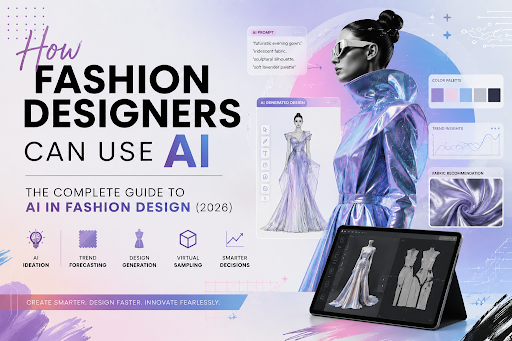
Artificial Intelligence is rapidly transforming the fashion industry. What once took weeks of sketching, sampling, styling, and campaign production can now be accelerated using AI-powered tools and intelligent automation.
Today, AI is no longer just a futuristic trend in fashion. It has become a practical creative assistant used by fashion designers, stylists, brands, content creators, and fashion startups across the world. From generating mood boards and predicting trends to creating virtual try-ons and AI-powered campaigns, AI is changing how designers think, create, market, and sell fashion.
However, one of the biggest misconceptions is that AI replaces creativity. In reality, AI works best when combined with human imagination, storytelling, design thinking, and artistic direction. Instead of replacing designers, AI helps remove repetitive creative bottlenecks so designers can focus more on innovation and originality.
This guide explains how fashion designers can use AI, the best AI tools for fashion design, practical workflow applications, future industry trends, and why AI is becoming one of the most valuable skills in modern fashion.
What Is AI in Fashion Design?
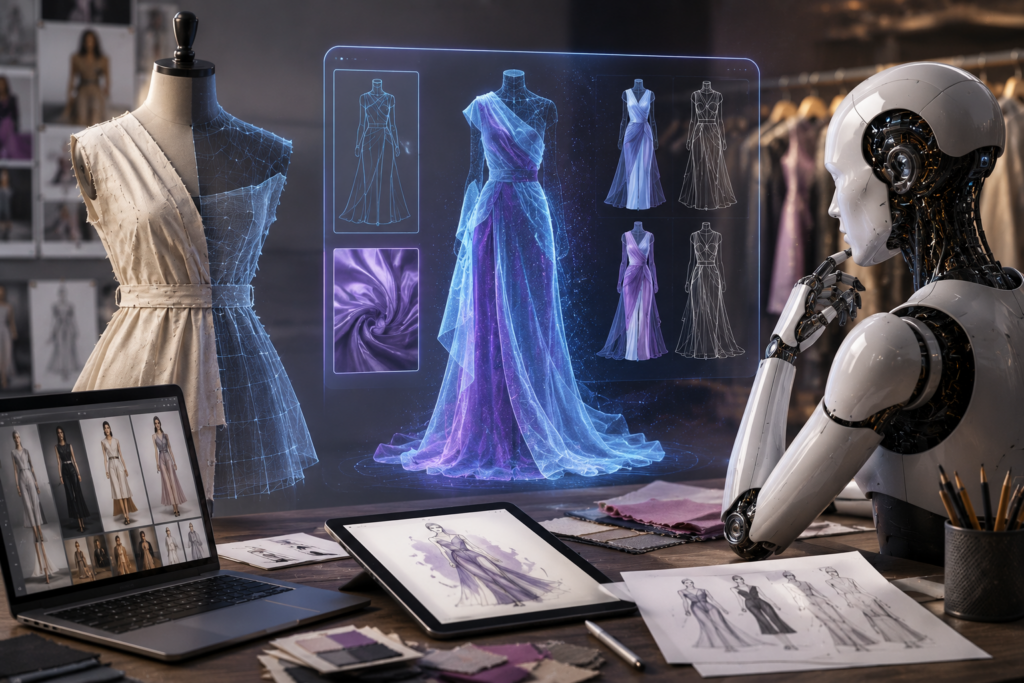
AI in fashion design refers to the use of artificial intelligence technologies to assist with various creative and business processes in fashion. This includes design generation, trend forecasting, styling, textile creation, visual merchandising, fashion marketing, and virtual garment visualization.
AI systems analyze massive amounts of data from:
- Social media
- Fashion websites
- Runway collections
- Shopping behavior
- Digital trends
This allows fashion brands and designers to make smarter and faster creative decisions.
Today, designers use AI for:
- Mood boards
- AI-generated sketches
- Digital garment rendering
- Styling assistance
- Virtual try-ons
- Fashion content creation
The combination of fashion and AI is creating an entirely new creative ecosystem.
The Shift from Traditional Design to AI-Powered Fashion
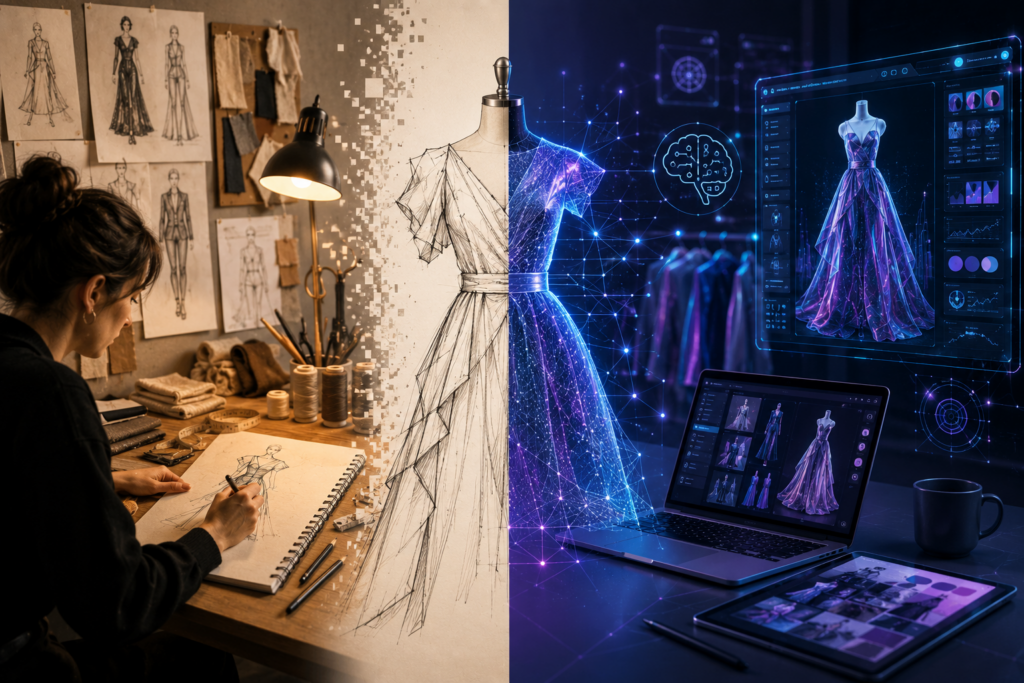
Traditional fashion workflows were highly manual and time-consuming. Designers often spent weeks researching references, building physical mood boards, sketching concepts, testing fabrics, and creating multiple physical samples.
AI introduces a new workflow where designers can use prompts, image references, and digital rendering systems to accelerate concept development significantly.
This does not remove creativity. Instead, it expands the designer’s ability to:
- Experiment faster
- Explore more concepts
- Visualize collections digitally
- Reduce unnecessary sampling
A designer can now test hundreds of silhouette variations, textile ideas, and color palettes before investing in physical production.
How Fashion Designers Can Use AI
AI can assist fashion designers across almost every stage of the creative process. From concept development to marketing, AI tools are becoming deeply integrated into modern fashion workflows.
1. AI for Fashion Sketching & Concept Generation
One of the biggest applications of AI in fashion is rapid concept ideation. Instead of manually sketching dozens of rough concepts, designers can use AI tools to instantly generate silhouettes, outfit structures, textile ideas, and styling variations.
Popular tools for AI sketching include:
- Midjourney
- DALL·E
- Adobe Firefly
For example, a designer working on futuristic streetwear could use a prompt like:
“Oversized cyberpunk streetwear collection with metallic textures, layered silhouettes, editorial runway aesthetic”
The AI can generate multiple creative visual directions within seconds.
Why It Helps
- Faster brainstorming
- More creative experimentation
- Rapid visual exploration
- Reduced concept development time
2. AI for Mood Boards & Fashion Inspiration
Mood boards help define the visual language of a fashion collection. They establish aesthetics, textures, styling references, color stories, and collection narratives.
AI tools now allow designers to generate entire mood boards using prompts and image references.
Popular themes designers explore include:
- Minimal luxury fashion
- Indian bridal fusion
- Sustainable streetwear
- Y2K runway aesthetics
Benefits of AI Mood Boards
- Faster inspiration gathering
- Better visual storytelling
- Improved creative clarity
- Efficient presentation development
3. AI for Trend Forecasting
Trend forecasting is one of the most powerful uses of AI in fashion. AI platforms analyze social media behavior, runway collections, influencer content, and shopping patterns to predict upcoming trends.
AI helps forecast:
- Trending fabrics
- Popular silhouettes
- Color palettes
- Consumer preferences
This reduces guesswork and helps fashion brands create collections aligned with market demand.
4. AI for Textile & Pattern Design
Fashion designers are increasingly using AI to generate textile prints, embroidery concepts, surface patterns, and fabric textures.
For example, a designer could enter:
“Luxury floral Indian textile pattern with gold detailing and earthy neutral palette”
The AI instantly generates multiple print variations for inspiration and development.
AI significantly reduces the time spent on:
- Print development
- Surface design
- Textile experimentation
This allows designers to focus more on refinement and creative direction.
5. AI for Sketch-to-Render Transformation
One of the most exciting AI innovations in fashion is the ability to convert rough sketches into realistic garment renders.
Designers can upload:
- Hand sketches
- iPad drawings
- Flat line art
AI tools then transform them into textured garments with realistic draping and styling.
This helps designers evaluate garment structure, fabric behavior, and visual appeal before physical sampling begins.
6. AI for Fashion Styling
AI is also transforming fashion styling through personalized outfit recommendations and digital styling systems.
AI styling tools analyze:
- Body shape
- Color preferences
- Shopping habits
- Style behavior
Based on this data, they generate coordinated outfit suggestions and personalized fashion recommendations.
Popular AI Styling Platforms
- DRESSX
- Style DNA
AI styling is becoming increasingly important in e-commerce and digital fashion retail.
7. AI for Virtual Try-Ons
Virtual try-on technology is becoming one of the biggest innovations in fashion retail. AI-powered systems allow customers to digitally preview garments and visualize clothing fit online.
These systems analyze:
- Body measurements
- Garment proportions
- Facial structures
This creates realistic digital fittings and improves online shopping confidence.
Benefits of Virtual Try-Ons
- Reduced product returns
- Better customer confidence
- Enhanced online shopping experience
- Increased conversion rates
Companies like SpreeAI are actively developing this technology.
8. AI for Fashion Marketing
Fashion marketing now relies heavily on AI-powered content creation tools. Brands use AI for campaigns, social media, email marketing, product descriptions, and ad creatives.
Popular AI marketing tools include:
- ChatGPT
- Canva
- Runway
Why Designers & Brands Use AI Marketing Tools
- Faster content production
- Better creative consistency
- Scalable campaign creation
- Improved social media workflow
AI helps brands maintain a consistent digital presence while reducing production time.
9. AI for Fashion Content Creation
Modern fashion brands are also content brands. AI now helps designers create lookbooks, fashion campaigns, reels concepts, editorials, product imagery, and even digital avatars.
Strong visual content has become essential for:
- Instagram growth
- E-commerce sales
- Influencer marketing
- Fashion branding
AI allows fashion creators to produce high-quality visual content much faster than traditional production methods.
10. AI for Digital Fashion & Virtual Clothing
Digital fashion is an emerging category where garments exist entirely online. Designers can now create virtual clothing for gaming, metaverse experiences, digital editorials, and online avatars.
Digital fashion includes:
- Virtual garments
- NFT fashion
- Gaming outfits
- Metaverse collections
This space is opening entirely new creative and business opportunities for fashion designers.
The Designer’s AI Prompt Formula
To get professional-quality outputs from AI tools, fashion designers need to write detailed and structured prompts.
A strong AI fashion prompt usually includes:
Garment Type + Silhouette + Fabric + Texture + Color Palette + Styling Context + Lighting Style
For example:
Weak Prompt
“Beautiful blue dress”
Strong Professional Prompt
“Asymmetrical corseted silk midi dress with architectural draping, monochromatic cerulean palette, editorial Vogue-style lighting, luxury runway aesthetic”
Better prompts usually produce:
- More realistic visuals
- Stronger silhouettes
- Better textures
- Higher-quality fashion outputs
Best AI Tools for Fashion Designers
| AI Tool | Best Use | Beginner Friendly | Free/Paid |
| ChatGPT | Content, branding, strategy | Yes | Free/Paid |
| Midjourney | Fashion visuals & concepts | Medium | Paid |
| DALL·E | AI-generated fashion imagery | Yes | Free/Paid |
| Adobe Firefly | Fashion graphics & visuals | Yes | Paid |
| Canva | Branding & social media | Yes | Free/Paid |
| Runway | AI campaigns & video | Medium | Paid |
| CLO 3D | Virtual garment simulation | Medium | Paid |
Can AI Replace Fashion Designers?
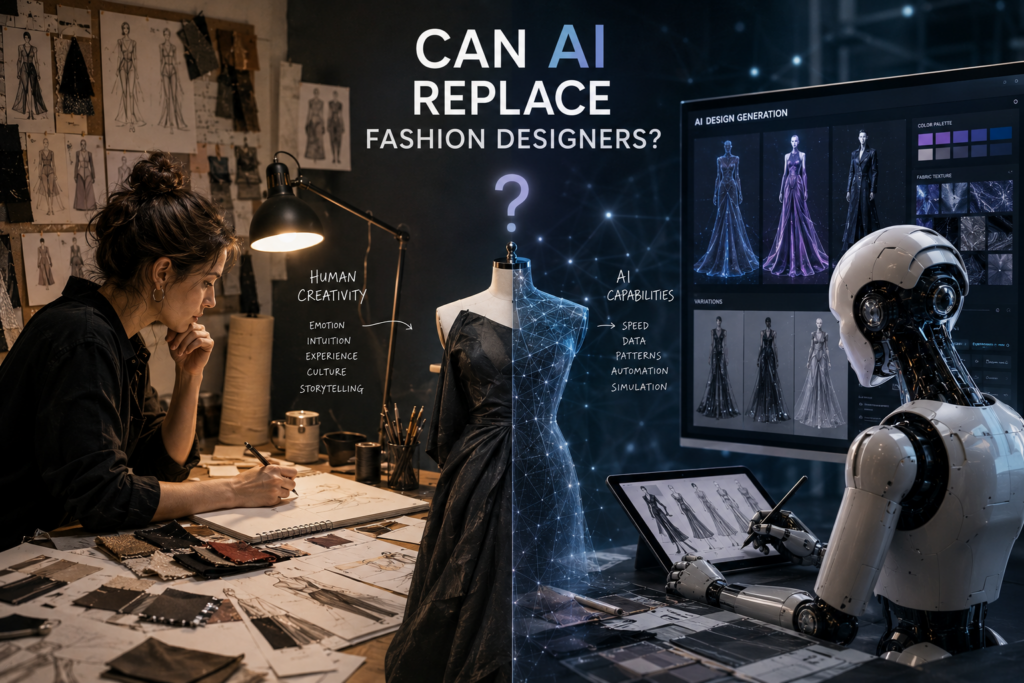
No, AI cannot fully replace fashion designers.
AI can automate repetitive tasks, generate concepts, analyze trends, and speed up workflows. However, fashion still depends heavily on human creativity, emotional storytelling, taste, cultural understanding, and artistic direction.
AI may become a powerful assistant, but human imagination remains at the center of fashion design.
Conclusion
Artificial Intelligence is reshaping the fashion industry in powerful ways. From sketch generation and trend forecasting to virtual try-ons and digital fashion, AI is helping fashion designers work faster, smarter, and more creatively.
However, AI should not be viewed as a replacement for designers. The future of fashion belongs to creatives who understand how to combine human imagination, emotional storytelling, branding, and artistic direction with AI-powered efficiency.
For modern fashion professionals, learning how to use AI effectively is becoming one of the most valuable skills in the industry.
Frequently Asked Questions
How is AI used in fashion design?
AI is used for sketching, trend forecasting, styling, textile generation, virtual try-ons, marketing, and fashion content creation.
What are the best AI tools for fashion designers?
Popular tools include ChatGPT, Midjourney, Adobe Firefly, DALL·E, and CLO 3D.
Can AI create fashion designs?
Yes. AI can generate fashion concepts, patterns, silhouettes, and visual inspirations based on prompts.
Will AI replace fashion designers?
No. AI can assist workflows, but creativity, storytelling, cultural understanding, and artistic direction still require human designers.
Is AI useful for fashion students?
Yes. AI helps students create mood boards, portfolio visuals, styling ideas, and fashion content more efficiently.
What is the future of AI in fashion?
The future includes digital fashion, virtual try-ons, AI-generated campaigns, personalized styling, and AI-powered fashion experiences.